As an Amazon Associate, VEOJEIN earns from qualifying purchases made through links on this site. This never changes the price you pay.
The short version: Most office decor advice falls into one of two camps: corporate-blandness ('add a plant!') or wellness-influencer aesthetics ('reset your space with vibes'). Both miss the actual point.
Most office decor advice falls into one of two camps: corporate-blandness ('add a plant!') or wellness-influencer aesthetics ('reset your space with vibes'). Both miss the actual point. The objects on your desk affect how you feel about your work in small, persistent ways, research on environmental psychology backs this up. But it's not about plants and candles. It's about objects with weight, story, and a personal connection. Here's the case for fewer, better things.
What the research actually shows
Cornell environmental psychology research on workspace personalisation found that workers who personalised their desks reported higher job satisfaction, lower stress, and slightly better focus than workers in identical but impersonal spaces. The effect sizes were small but consistent.
Crucially, the type of personalisation mattered. Workers who added objects with personal stories (family photos, travel souvenirs, meaningful gifts) reported larger benefits than workers who added generic decorative items (plants, art prints, motivational posters).
The mechanism appears to be twofold: visible reminders of your life outside work reduce the feeling of identity collapse during long work days, and meaningful objects provide brief 'recovery moments' when your eye lands on them between tasks.
The seven-piece desk
A workable office desk has about seven non-functional objects (in addition to your monitor, keyboard, mouse, notebook, and a pen).
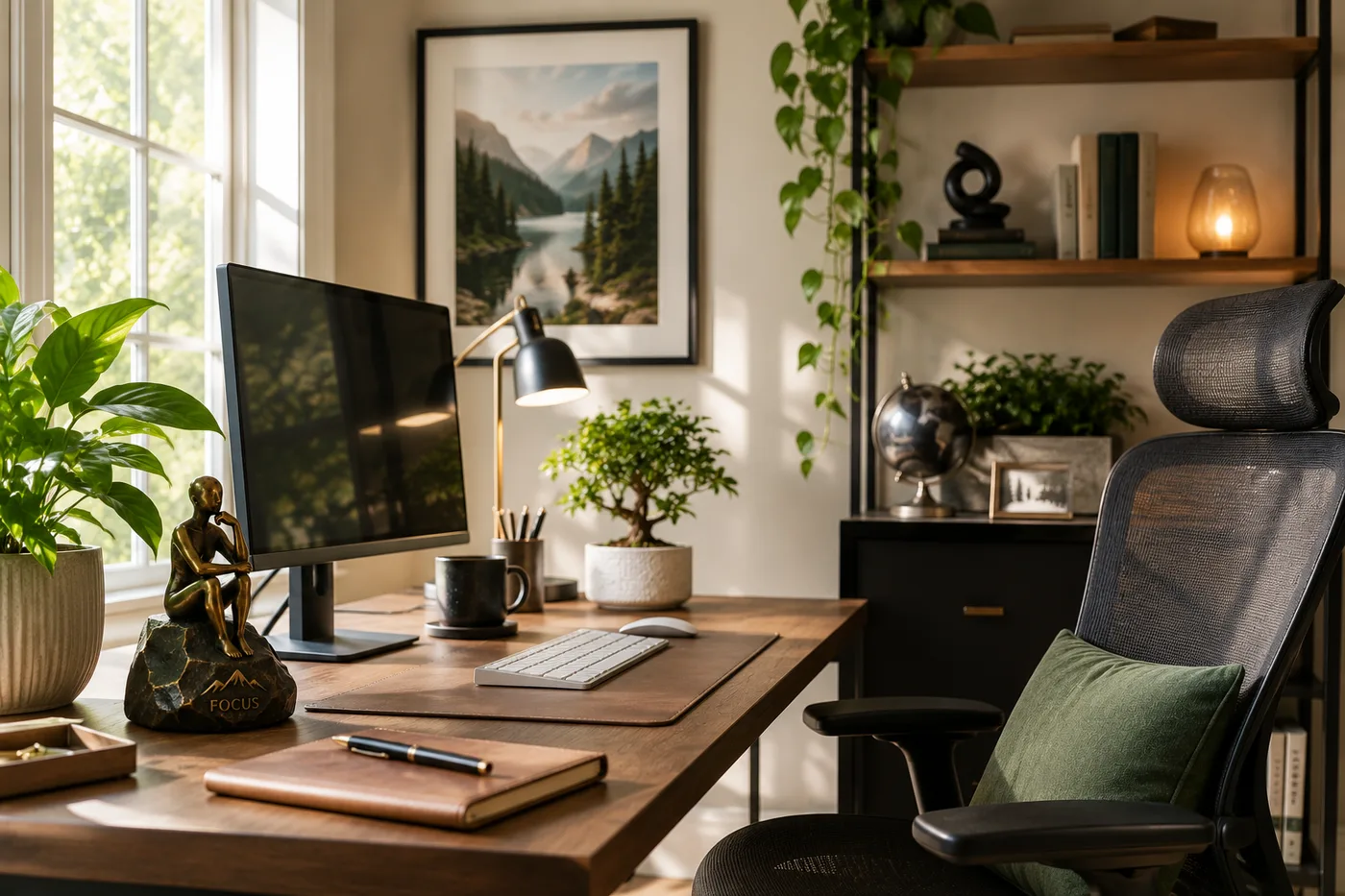
Object 1: A single anchor object. A fossil replica, a small sculpture, a substantial paperweight. Sits prominently. Visible on Zoom.
Object 2: A photo of someone you love. One frame, simple style. Placed at eye level when seated, slightly to one side.
Object 3: A plant. Low-maintenance (snake plant, ZZ plant, pothos). Watered weekly, not fussed over.
Object 4: A meaningful book. Hardcover, related to your interests, sits with the spine visible. Acts as a small reminder of who you are outside work.
Object 5: A small inspirational figurine. A hedgehog, a lion cub, or anything with a personal meaning. Subtle inscription or none, it should read as art with embedded meaning.
Object 6: A small cup or bowl for incidentals (paperclips, coins, a chapstick). Better than scattered items.
Object 7: A piece of natural curiosity, a polished stone, a small fossil, an amber resin paperweight. Adds tactile interest.
What to remove
Stale flowers, dead plants, dried-up succulents. They signal neglect, which is the opposite of what desk decor should do.
Excessive memorabilia. Three coffee mugs, four family photos, five souvenir pencils. Each was meaningful once; together they're clutter.
Generic motivational items. Anything mass-produced with 'Hustle', 'Boss Energy', or similar fonts on it.
Multiple plants if you can't keep them alive. One thriving plant beats four struggling ones.
Cables. Box of office supplies. Anything that suggests 'I haven't tidied up'.
Lighting changes everything
Most offices have overhead fluorescent or LED lighting that's cool-temperature (5000-6500K). It's good for general illumination, terrible for making a desk feel inhabited.
Adding a single warm-temperature (2700-3000K) desk lamp transforms how the space feels. The warm light makes wood, resin, brass, and natural materials look richer. It also gives a Zoom call a much more flattering background than overhead lighting alone.
Place the desk lamp on the side opposite your dominant hand, angled slightly toward the desk surface. The pool of warm light should illuminate your anchor object and the area where you work, not your face directly.
How to know it's working
You notice the objects briefly during the day, your eye lands on the fossil while you're on hold, the photo catches your attention between meetings, and the brief glance produces a small positive feeling rather than nothing.
Visitors comment, but rarely. The objects should reward inspection but not demand it.
After three months, you wouldn't easily part with the arrangement. The desk has become a place rather than a generic workstation.
If none of these are true, change something. The wrong objects are worse than no objects, they accumulate as clutter without providing the recovery moments that make decor useful.
Frequently asked questions
Does desk decor actually affect productivity?
Modestly. Cornell research from 2014 and follow-up studies show that personalising your workspace correlates with higher reported engagement and slightly lower stress. The effects are small (~5-10% on self-report measures) but consistent.
How many objects should I have?
Fewer than feel natural. Most desks accumulate clutter; the best desks have 3-5 carefully chosen objects in their non-functional space and nothing else. Each should have a reason for being there.
Do plants count?
Yes, but they're overrated. A single low-maintenance plant is good. Three or four plants becomes a maintenance liability. Real plants beat fake ones for the small but real air-quality and psychological benefits.
What about photos of family?
One framed photo of someone you love is meaningful. A row of family photos starts to look like a shrine and competes with the work. Pick one photo, frame it well, place it where you'll see it during phone calls (it shows on Zoom and reads as personal).
Is it OK to have inspirational quotes?
Discreetly, yes. A small inscribed object (a paperweight, a figurine with a quote on its base) works. A large quote-on-a-poster doesn't survive professional inspection.