As an Amazon Associate, VEOJEIN earns from qualifying purchases made through links on this site. This never changes the price you pay.
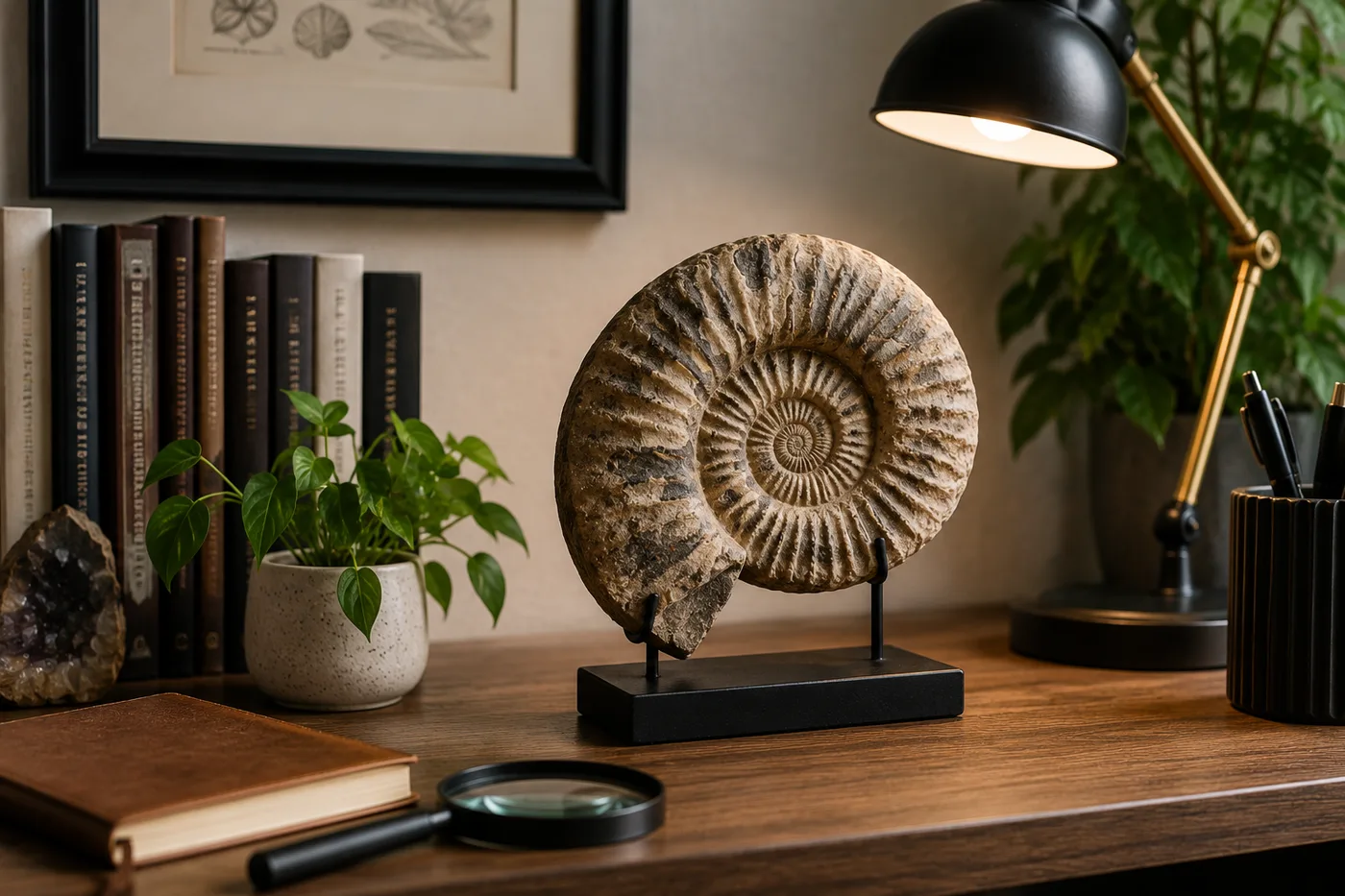
The short version: A fossil replica should look like an object someone deliberately chose, not like a tchotchke that just ended up there. The difference comes down to placement, lighting, and what you put next to it.
A fossil replica should look like an object someone deliberately chose, not like a tchotchke that just ended up there. The difference comes down to placement, lighting, and what you put next to it. This guide collects five specific display setups that work, drawn from how museum curators and interior designers actually stage natural-history objects.
1. The desk anchor
A single fossil replica on a clean desk does more than a dozen smaller objects scattered around. The trick is scale: pick a piece roughly the size of your closed fist or larger. Anything smaller disappears against a monitor.
Place it on the side of your desk closest to your dominant hand, not directly in front of you. You want it in your peripheral vision during work, and prominent in your camera frame during video calls. Pair it with a small plant or a single hardcover book, never more than two adjacent objects.
Why this works: the eye reads a desk as a workspace, and a single sculptural object breaks that pattern enough to register as "interesting" without competing with your work.
2. The shelf vignette
Three objects, one shelf, an odd ratio of heights. That's the museum-curator formula for a vignette.
Put a tall object on one side (a book stood vertically, a tall vase, or a candle). Place the fossil replica roughly in the middle. Add a small, flat object on the other side (a tray, a small framed print, or a folded textile). The eye triangulates between the three, and the fossil reads as the focal piece because of its weight and sculptural quality.
Avoid lining up multiple fossils side-by-side. They cancel each other out. If you own several, rotate them, display one at a time, store the rest, swap every few months.
3. The backlit windowsill
Translucent resin pieces are made for this. A south- or east-facing windowsill becomes a natural light box: when the sun passes through the amber-coloured resin, the inclusion seems to glow from within.
The setup is simple. Place the piece on a small wooden cutting board or a flat stone slab on the sill. The neutral base anchors it and protects the sill paint from heat. Skip a doily or fabric, it cheapens the effect.
Best times of day: morning for east-facing windows, late afternoon for west. The piece becomes most striking when the sun is low.
4. The natural-history cluster
If you want to lean into the museum aesthetic, group three to five small natural-history objects on a tray.
Mix textures: one resin amber piece, one geological specimen (a polished agate, a chunk of pyrite, a piece of obsidian), one botanical (a dried seed pod, a small framed leaf pressing). Optional: a small magnifying glass and a folded scrap of brown paper labelled in a fine-tip pen, "Cretaceous, ~99 mya", for the cabinet-of-curiosities feel.
Trays should be neutral: dark walnut, raw brass, or matte black ceramic. The tray contains the cluster and turns it from "random stuff" into "a collection".
5. The office conversation piece
Workplaces benefit from one or two genuinely interesting objects. A fossil replica on a meeting room shelf, executive desk, or reception counter does more for the room than a dozen framed motivational posters.
The specific recommendation: a dinosaur footprint replica (large enough to read as a "thing", roughly 25 × 25 cm) on the bookshelf behind your desk. People notice it on Zoom calls. They ask about it. You have a one-sentence story ready: "It's a cast of an actual Cretaceous footprint, I'll send you the link."
This converts a passive office decoration into an active relationship tool. Memory and conversation come back to that object every time someone walks in.
What not to do
Don't display fossil replicas on a coffee table next to coasters and remote controls. The visual context demotes them.
Don't put a glass dome over a small resin piece. It reads as twee. Resin doesn't need protecting like a real fossil would.
Don't surround them with kitsch, plastic dinosaurs, dinosaur-themed mugs, anything that breaks the natural-history feel. The piece itself is the joke; you don't need to underline it.
Frequently asked questions
Where should I put a fossil replica?
Eye level on a shelf, on a desk where you'll see it during phone calls, or on a windowsill where light passes through it. Avoid clusters on a coffee table, single pieces command more attention.
Does sunlight damage resin?
Premium UV-stable resin (used by VEOJEIN) is fine in direct sunlight for years. Lower-grade resin yellows in 12–18 months, keep cheaper pieces in indirect light.
How do I clean a resin fossil?
Wipe with a soft microfibre cloth and warm water. For stubborn smudges, a drop of mild dish soap. Never use alcohol, ammonia, or acetone, they cloud the surface.
Can I display fossils with other collectibles?
Yes. Pair them with small books, vintage botanical prints, brass items, or small succulents. Avoid pairing with toys or novelty items, it cheapens the natural-history feel.