As an Amazon Associate, VEOJEIN earns from qualifying purchases made through links on this site. This never changes the price you pay.
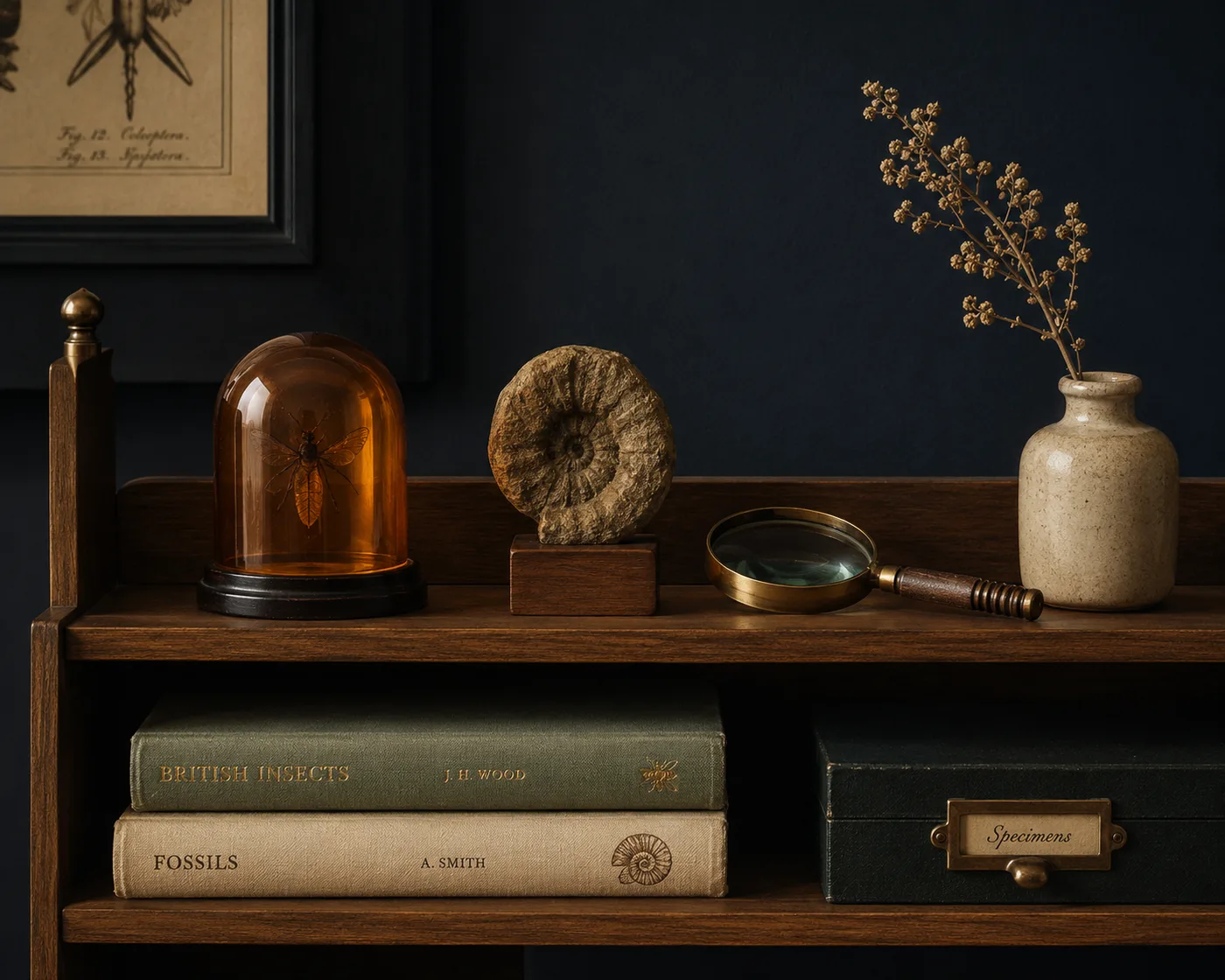
The short version: Between the 1500s and the 1800s, wealthy Europeans assembled cabinets of curiosities, rooms full of natural specimens, fossils, art, scientific instruments, and ethnographic artefacts. They were the precursors to modern museums and a way for educated people to display what they'd learned about the world.
Between the 1500s and the 1800s, wealthy Europeans assembled cabinets of curiosities, rooms full of natural specimens, fossils, art, scientific instruments, and ethnographic artefacts. They were the precursors to modern museums and a way for educated people to display what they'd learned about the world. The aesthetic is back, in a quieter form. A modern cabinet of curiosities works as a focal piece in a home: a single shelf or cabinet that collects meaningful objects rather than decorative stuff. Here's how to build one without it looking like a thrift-store explosion.
Why the form survived 500 years
Cabinets of curiosities served two needs that haven't gone away. The first was educational: in an era before public museums, owning specimens was the only way most educated people could study natural history. A cabinet might contain a polished agate, a preserved insect, a Roman coin, and a leather-bound atlas. Visitors would be walked through it as a kind of physical encyclopaedia.
The second was social: cabinets advertised the owner's taste, education, and connections. A wealthy person who'd commissioned expeditions, traded with collectors, and read widely could show all of that in one room. The cabinet was a status object in the same way a personal library was, and often co-located with one.
Both needs still exist. We can buy or borrow knowledge from the internet, but objects still serve as anchors for what we care about. A cabinet today does the same job in miniature: it's a physical commitment to a few areas of interest and a quiet signal to anyone who visits.
Three modern approaches
The natural history cabinet. Fossils, geological specimens, dried botanical pressings, antique field guides, a magnifying glass. Anchor object: a fossil or amber resin piece. Pair with dark wood shelving, brass details, and a single warm light source.
The literary cabinet. Vintage books (chosen for binding, not content), a brass desk lamp, antique writing instruments, a small bust or framed portrait. Anchor object: a hardcover edition of something meaningful. Works best with leather-bound or cloth-bound books.
The travel cabinet. Objects collected from places that meant something. A small piece of stone from a hike, a bound notebook, a brass compass, a folded paper map. Anchor object: a sentimental piece, the literal pebble from a meaningful trip. The aesthetic is more personal and harder to fake.
Composition rules
Mix heights. A flat shelf of objects all at the same height reads as a museum gift-shop display. Variety in height (using small stacks of books, plinths, or naturally tall objects) gives the eye a path to follow.
Group in threes. Two objects look like a pair. Four can balance. Three creates an asymmetric triangle that the eye finds satisfying. Most curated arrangements break down into clusters of three with negative space between them.
Include negative space. The empty parts of a shelf are as important as the objects. They give the items room to breathe and prevent the cluttered look. Aim for 50% empty surface area in any single shelf.
One contradiction. Every great cabinet includes one object that doesn't quite fit, a brightly coloured oddity in an otherwise neutral palette, a perfectly modern object among antiques. The contradiction signals that the curator was choosing on personal taste, not following a formula.
What to avoid
Mass-produced themed décor. A plastic skull, a generic globe, a fake aged-looking book with no spine title. These read as set-dressing and undermine the rest of the arrangement.
Too many objects. The collection should feel like it was assembled by a person, not a store buyer. Buying 20 items at once for a cabinet is a tell.
Direct lighting from above. Spotlights make small objects look like merchandise. Use ambient light or single warm-temperature lamps placed at table height, not above.
Glass domes on everything. Cloches can work for delicate single specimens but become twee when overused. One cloche per cabinet, maximum.
Where to start if you don't have anything
The fastest path is to pick a category that already interests you and commit to it. Geology and natural history are the easiest because the objects are cheap (polished stones start at $5, fossil replicas at $15) and intrinsically interesting. Literary cabinets work if you already own books worth looking at. Travel cabinets work if you've travelled deliberately.
Buy or find your first anchor piece, something substantial enough to be the focal object of a shelf. Resin amber pieces are ideal anchors because they're optically interesting from any angle. Build around it slowly. The cabinet should reveal itself over time, not be finished in a weekend.
Frequently asked questions
What's a cabinet of curiosities?
Historically: a room full of natural specimens, artefacts, and instruments collected by wealthy Europeans to display their knowledge of the world. Today: a shelf or display piece that collects meaningful objects, fossils, natural specimens, vintage scientific instruments, books, rather than purely decorative items.
How many objects should I display?
Fewer than you think. A great cabinet has 7-15 carefully chosen objects, not 50. The eye reads sparse arrangements as deliberate and crowded ones as cluttered. Start with 5-7 anchor pieces and add only when something genuinely earns its place.
Do the objects need to match?
No, diversity is the point. But they should share a feeling. A fossil, a brass compass, a piece of obsidian, and a leather-bound book belong together not because they look alike but because they all have the quality of meaningful objects with history. Avoid mixing serious objects with mass-produced décor.
What kind of furniture works?
Open shelving (industrial or vintage wood) for visibility. A glass-front cabinet for protection. A shadow box for wall display. Avoid solid-door cabinets, objects you can't see are objects that don't contribute to the room.
Is this just hoarding with better lighting?
It can be if you're not careful. The line between curated collection and clutter is the willingness to remove things. A great curator regularly retires objects to storage and rotates them. Hoarding only adds; curating both adds and subtracts.