As an Amazon Associate, VEOJEIN earns from qualifying purchases made through links on this site. This never changes the price you pay.
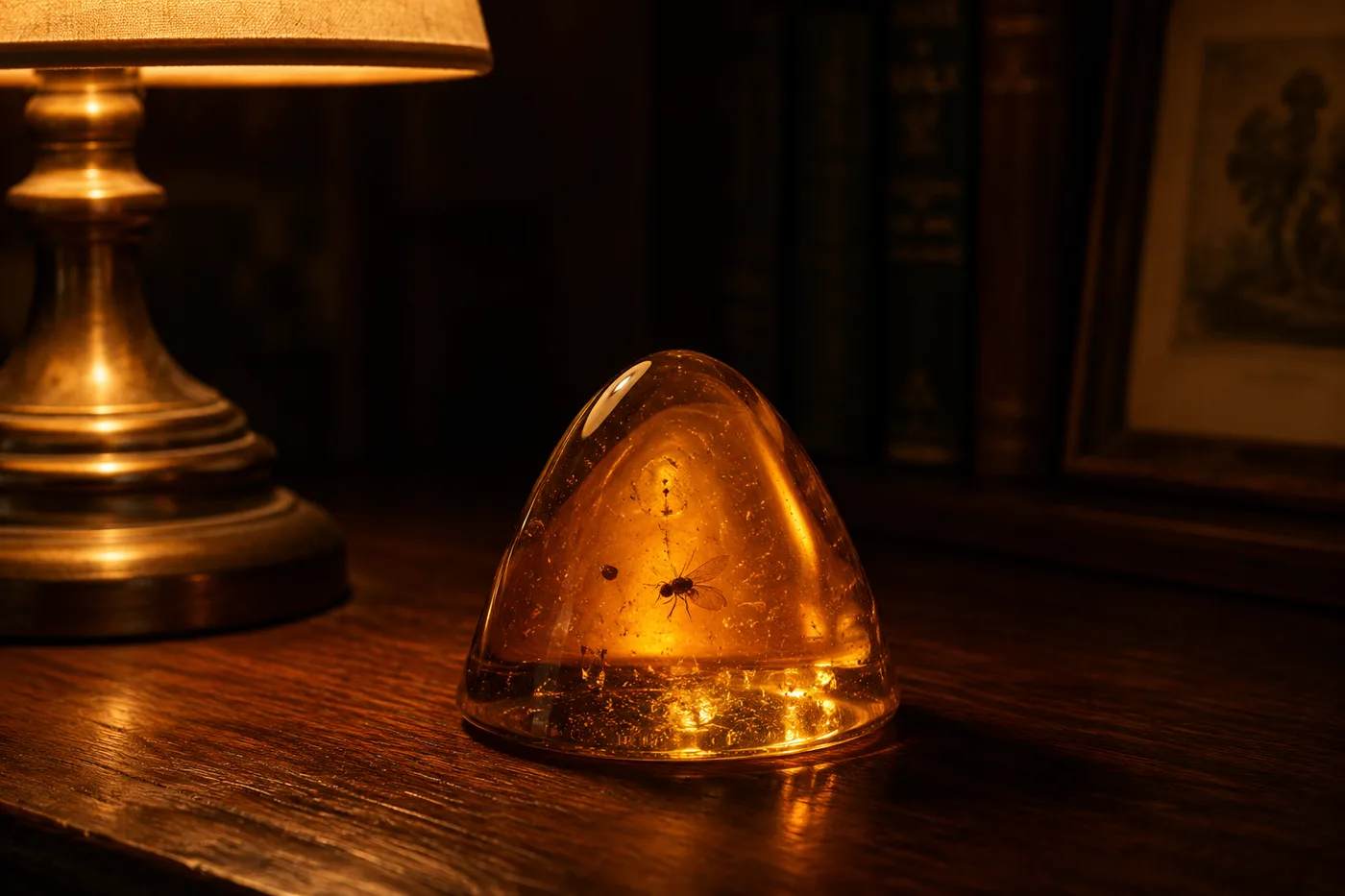
The short version: Lighting is what separates a resin piece that looks like 'a thing on a shelf' from one that looks like a museum specimen. The same mosquito-in-amber paperweight under flat overhead LED reads as a beige blob. Backlit at a 30-degree angle with a warm 2700K bulb, it reads as the centerpiece of the room.
Lighting is what separates a resin piece that looks like 'a thing on a shelf' from one that looks like a museum specimen. The same mosquito-in-amber paperweight under flat overhead LED reads as a beige blob. Backlit at a 30-degree angle with a warm 2700K bulb, it reads as the centerpiece of the room. This guide walks through bulb temperature, position, beam angle, and a few cheap upgrades that take a display from forgettable to fixed-attention.
The two things lighting has to do
For translucent pieces, amber, resin, glass, alabaster, lighting has two jobs: reveal the interior, and define the silhouette.
Top-down overhead lighting only does job two: it shows you the outside shape but turns the interior dark. That's why pieces with embedded inclusions (mosquitoes, fossils, flowers, DNA strands) lose their entire point under standard ceiling lighting, the inclusion vanishes into shadow.
Backlighting or side-lighting at a low angle does both: photons pass through the piece, light up the interior, and the outline still reads against the background. This is what museum display cases do, and it's stupidly easy to copy at home for under $30.
Bulb temperature, the Kelvin question
Bulb color is measured in Kelvin. Lower = warmer/yellower. Higher = cooler/bluer.
2700K (warm white): candlelight-like, deeply golden. Perfect for cognac and honey amber. Makes resin look 'expensive.' What to use in living rooms, bedrooms, displays you want to feel cozy.
3000K (soft white): still warm but slightly more white. Good general-purpose for amber. The bulb that disappoints no one.
4000K (cool white / 'natural'): daylight-leaning. Makes amber look slightly green-yellow. Avoid for warm-toned resin pieces. OK for clear glass or lemon amber.
5000-6500K (daylight): harsh, blue-leaning. Kills amber's warmth. Only use for color-accurate photography or for green/blue resin pieces.
Default to 2700K-3000K for any amber or warm-toned resin display. If you can't change the room bulb, get a small puck light or strip light with its own bulb.
Position and angle, the cheap upgrade that matters most
Three positions, ranked best to worst for translucent pieces:
1. Backlit (light behind the piece, aimed forward through it). Best result. Reveals every internal inclusion. Use a small puck light or candle behind, or set the piece in front of a window at golden hour.
2. Low-side angle (light at ~30° from horizontal, hitting one side). Second best. Creates dramatic internal glow and visible shadow that defines silhouette. Most museum cases use this.
3. Direct overhead. Worst for translucent pieces. Flat. Inclusions disappear. Acceptable for opaque or polished pieces only.
If you do one thing differently with your display: put a $12 USB-rechargeable puck light *behind* the piece instead of above it. That single change makes a $40 piece look like a $400 piece.
Beam angle and intensity
Narrow beam (15-25°) creates a tight spotlight effect, dramatic, museum-like, but throws hard shadows. Use for solo display pieces.
Wide beam (60°+) floods the whole shelf, softer, less dramatic, but reveals more pieces at once. Use for grouped collections.
Don't over-light. A 200-lumen puck on a small shelf is plenty. 800+ lumens washes out the amber's interior color, instead of glowing cognac it looks pale and overlit. Less is genuinely more here.
Practical shelf setup, $30 budget
Buy: (1) one USB-rechargeable 200-lumen puck light at 2700K (~$12), (2) a small piece of black or dark-wood backing board cut to shelf width (~$8), (3) a 2-pack of stick-on diffuser strips or frosted tape (~$5), (4) a microfiber cloth (~$3).
Setup: mount or position the puck light *behind* the piece, low and angled forward. Stand the piece on the dark backing board so its silhouette pops. Use the diffuser strip over the puck to soften any harsh hotspot.
Test: take a phone photo with the room lights off. If the piece glows from the inside in the photo, you nailed it. If it looks flat, move the puck lower and further back until you see internal glow.
Frequently asked questions
Can I use the flashlight on my phone to test lighting before buying lights?
Yes, and you should. Most phone flashlights are around 5000K (cool), which is the worst case for amber, but it lets you test position. If your piece looks acceptable with phone-light positioning, it'll look great with a proper 2700K bulb in the same spot.
Do LED lights damage amber or resin over time?
Quality LEDs at indoor display intensities don't emit meaningful UV, they're safe. Avoid: sunlight (direct, all-day exposure can yellow some resins over years) and fluorescent tubes (some emit UV-A). LED puck lights are the safest choice.
Should I put a glass case over an amber display?
Only if dust is a real problem (high-foot-traffic room, pets, near a kitchen). Glass cases dim the piece and reflect light. For most home displays, an open shelf with a quick weekly dusting looks better.
What's the difference between 'warm white' bulbs from different brands?
'Warm white' isn't standardized, it could mean 2700K or 3000K depending on the brand. Always look at the Kelvin number on the box, not the marketing word. 2700K = candlelight warm. 3000K = soft white.
How do I light a screen-accurate mosquito-in-amber piece for max wow factor?
Backlight at 2700K with a narrow 25° beam, set the piece on dark wood, and position so a light beam passes directly through the mosquito inclusion. The bug becomes the focal point, exactly like the screen-accurate cane prop. VEOJEIN's mosquito-in-amber pieces are designed for this kind of backlight setup.