As an Amazon Associate, VEOJEIN earns from qualifying purchases made through links on this site. This never changes the price you pay.
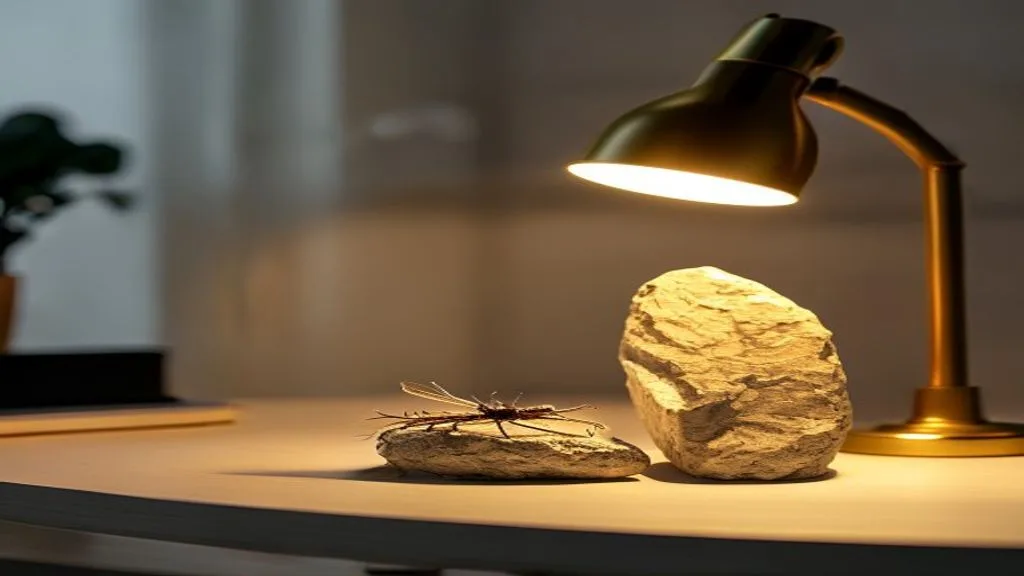
The short version: The 1993 dinosaur-blockbuster moment made a chunk of fossilised tree resin instantly recognisable to a billion people. The walking-stick handle, the mosquito frozen mid-flight, the line about "DNA preserved", the image is one of the most reproduced in pop culture.
In 1993, a single blockbuster did something no science textbook had managed: it made a chunk of fossilised tree resin instantly recognisable to a billion people. The walking-stick handle, the mosquito frozen mid-flight, the line about "DNA preserved", the image is one of the most reproduced in pop culture. Three decades later, the mosquito-in-amber paperweight is a desk fixture in offices around the world. Here's the science the story borrowed, what it got right and wrong, and how the image became furniture.
What Michael Crichton actually based it on
Crichton's 1990 novel cites a real 1982 paper by George Poinar, an entomologist at Oregon State University. Poinar had recovered tiny fragments of DNA from a stingless bee preserved in 40-million-year-old Dominican amber. The novel takes that genuine finding and imagines extending it: full genomes recovered from blood-fed prehistoric mosquitos, cloned to make dinosaurs.
Poinar's work was groundbreaking but limited. The DNA fragments he found were short and incomplete. Over the following decades, multiple attempts to repeat the finding revealed how easily ancient DNA samples are contaminated by modern lab DNA. By the early 2000s, the consensus was that intact ancient DNA from amber-trapped specimens couldn't be recovered.
The film exists in the gap between what was suggested in 1980s research and what was scientifically realistic. As pop culture, it works. As science, it's mostly fiction.
The biology of a blood-feeding insect preservation
Modern mosquitos are between 2 and 19 millimetres long, with the females (the ones that bite) being slightly larger. Cretaceous-era mosquitos, recovered from Burmese amber, are a similar size, the basic body plan is roughly the same over 100 million years.
For a mosquito to end up perfectly preserved, it had to land on fresh resin (sticky enough to trap, not yet hardened), then be quickly covered by a second flow of resin. Trapped only on one side, the mosquito would be visible but partially decomposed. Fully embedded, every external feature is preserved, scales, antennae, the proboscis. In rare cases, the last meal is visible inside the body.
Researchers in 2013 reported finding hemoglobin proteins inside a Eocene-era mosquito in amber. The proteins matched modern mammalian blood. The finding suggests the mosquito had recently fed on a mammal before getting trapped, preserving its last act for 46 million years.
The 1980s breakthrough that wasn't
In 1992, Raul Cano and George Poinar reported recovering DNA fragments from a stingless bee preserved in 25-30 million-year-old Dominican amber. The 1993 publication of the result was timed with the release of Jurassic Park, and the cultural moment was electric. Scientists, science writers, and the general public all seemed willing to believe ancient DNA might be recoverable from much older specimens.
Within five years, several other labs tried to reproduce the work. None could. By 2013, a comprehensive review by Manchester University concluded that the recovered DNA was almost certainly modern contamination. The original specimens were intact, but the DNA inside them appeared to be from modern lab environments, researchers' skin cells, common bacteria, fungal spores.
The original research wasn't fraudulent, it was a real attempt to use cutting-edge techniques on real specimens. But the techniques weren't ready, and the controls weren't strict enough. The findings were a false positive, and the cultural moment had already moved past the science.
Why DNA breaks down faster in amber than expected
Amber feels like a perfect preservation medium. It's hermetic, water and oxygen can't get in once the resin has hardened. Insects inside amber are visibly intact for tens of millions of years. Intuitively, DNA should survive there.
The problem is that the insect's own enzymes don't stop working when the resin hardens. Cellular DNases, enzymes that chop up DNA, continue to work for a brief window after the animal dies. By the time the resin has fully polymerised and sealed the specimen, the DNA inside is already heavily fragmented.
Add 50-100 million years of slow chemical breakdown, and what's left is a fine dust of broken nucleic-acid fragments, far below the threshold needed for sequencing. The visible body is intact; the genetic information is gone.
What Jurassic Park actually got wrong
The film's premise has three biological errors stacked on top of each other. First, the dinosaur DNA assumed to be recoverable from a mosquito's blood meal would be 65+ million years old, far past any preservation limit, even in ideal conditions. Second, the 'frog DNA' used to fill gaps would not be a valid template because frogs and dinosaurs share too little DNA to bridge missing sequences. Third, building a functioning organism from a partial genome isn't a matter of filling gaps, it requires entire intact chromosomes with their regulatory machinery.
None of this matters for the film's drama, which is the point. Crichton structured his novel to acknowledge the science was extrapolated, with characters debating the ethics of even attempting it. The film softened those acknowledgements but they're there in the book.
What amber actually does preserve
The list is still remarkable. External anatomy down to wing-scale level. Setae (the tiny hairs on insects). Antennae structure. Mouthpart geometry. Pigment patterns in some cases. Preserved tracheal systems (the tubes insects breathe through). Even gut contents, researchers have identified the type of pollen ancient bees were carrying, and in one famous 2013 case, hemoglobin proteins from a 46-million-year-old mosquito's last blood meal.
What you can't get is sequence-level genetic data. What you can get is morphology in extraordinary detail, which has driven major advances in understanding insect evolution. Many extinct families and genera are known only from amber specimens.
Why the image works as a desk object
The mosquito-in-amber paperweight is one of the rare pop-culture references that doesn't feel cheap when you put it on an adult's desk. The reason is that the underlying object is genuinely interesting before you add the cultural reference. A piece of fossilised resin with a 100-million-year-old insect inside is a thing of substance, with or without the dinosaur-blockbuster connection.
The blockbuster just made the object legible to a wide audience. Without it, a mosquito in amber is for paleontology specialists. With it, a high-quality replica becomes a desk anchor, recognised, conversation-starting, slightly mysterious. The piece does work that a generic crystal or marble desk object can't.
Choosing a replica that doesn't look like a toy
Three things separate a sophisticated replica from a novelty item. First, the resin: the better pieces use UV-stable polyester with no cloudiness or yellowing. Hold it up to light, you should see the mosquito sharply, with no haze.
Second, the insect itself: 3D sculpts beat 2D printed images, every time. The 2D versions look fine from one angle and obviously fake from any other. A real 3D sculpt with correctly proportioned legs and wings holds up to close inspection.
Third, the base. A bare resin block looks like a paperweight. A piece on a wooden or stone base looks like a curated object. The base also stops the piece from rolling and protects the polished surfaces. For office or shelf display, the base matters more than people expect.
The reference everyone gets
If you put a high-quality mosquito-in-amber replica on your desk, you can be confident anyone above a certain age will recognise it. The blockbuster franchise that popularised the image has stayed in cultural circulation for three decades and shows no signs of fading. Sequels and a successful 21st-century reboot wave keep introducing new generations to the original imagery.
The signal you send isn't "I love dinosaur movies". It's "I appreciate objects with depth". That's a different impression, and it tends to land well in professional settings.
Frequently asked questions
Are mosquitos actually preserved in amber?
Yes. Mosquitos and related blood-feeding insects have been found in Burmese amber from roughly 99 million years ago. Some specimens have been so well preserved that scientists can examine the mouthparts in detail and even, in a few cases, identify what kind of blood the mosquito had been feeding on.
Did the dinosaur-cloning premise have any science basis?
The science was extrapolated, not invented. By 1993, researchers had recovered short fragments of DNA from amber-trapped insects. The dinosaur-cloning premise of the era's blockbuster fiction extended that into a complete dinosaur genome, which is biologically impossible, DNA breaks down too fast over geological time. But the seed of the idea was real research.
What's a 'mosquito in amber' paperweight actually made of?
The good ones are jeweller-grade polyester or epoxy resin in an amber colour, with a 3D-sculpted mosquito suspended inside. The best versions use anatomically accurate insect sculpts, polished by hand, and often mounted on a wooden or stone base.
How do you tell a good mosquito-in-amber replica from a bad one?
Three checks: the resin should be optically clear with no air bubbles around the insect; the mosquito should be a 3D sculpt visible from multiple angles (not a 2D image printed inside); the finish should be smooth without tool marks, with rounded polished edges. The base should feel substantial in the hand.
Why is this image so iconic?
It packs a remarkable amount of meaning into a single object, deep time, fragility, preservation, the link between the alive and the long-dead. The image works on first sight and rewards a closer look. Few pop-culture objects achieve both.
How rare is a real mosquito in amber?
Genuinely rare. Mosquitoes are uncommon in the amber and fossil record compared with midges, gnats, flies, and ants, which is part of why each new find draws scientific attention. Because true fossil specimens are so scarce, almost every mosquito-in-amber piece sold for display today, including VEOJEIN's, is a crafted resin replica rather than a genuine fossil.
What is the oldest known mosquito in amber, and what is it called?
The earliest known mosquito is Libanoculex intermedius, found in Lower Cretaceous amber from Lebanon and described in the journal Current Biology in 2023. It dates to the Early Cretaceous, well over 100 million years ago, pushing the mosquito record back beyond the better-known Burmese amber specimens from about 99 million years ago. Curiously, the preserved insects were males with piercing mouthparts, even though only female mosquitoes feed on blood today.
Can you buy a real mosquito in amber, and is it expensive?
Authentic fossil inclusions exist but are rare, and a genuine specimen with a clearly visible insect can be costly and hard to verify. For that reason most mosquito-in-amber pieces offered for display, including VEOJEIN's, are honestly presented as resin replicas: a 3D-sculpted mosquito suspended in amber-colored resin, made to capture the look at a fraction of the cost and with none of the authenticity risk.
Does amber keep mosquitoes away?
There is a long-standing folk belief that Baltic amber repels insects, but there is no solid scientific evidence that wearing or displaying amber keeps mosquitoes away. Amber's real link to mosquitoes is the opposite and far older: it occasionally trapped and preserved them tens of millions of years ago.
Why does DNA degrade?
DNA is a long, fragile molecule held together by chemical bonds that slowly break down even in ideal preservation conditions. Water, oxygen, radiation, and naturally occurring enzymes called nucleases all attack DNA over time. The half-life of DNA in a fossil setting is estimated at 521 years for fragments, meaning DNA breaks down to undetectable levels in about 6.8 million years.
What's the oldest verified DNA ever recovered?
Around 1-2 million years from permafrost-preserved mammoth and other Arctic mammal specimens. The cold and absence of oxygen in permafrost are far better DNA preservation conditions than amber. Even there, the recovered DNA is heavily fragmented.
Could we ever clone an extinct species?
For species that went extinct recently (under 100,000 years), possibly, the mammoth project being the most serious effort. For dinosaurs (extinct 66 million years), no. The DNA is gone. The closest path to a 'dinosaur-like' animal is reverse genetic engineering of bird embryos to express ancestral traits, which is being attempted but only at the level of small features like teeth.
What is the closest living thing to a dinosaur?
Birds. Modern birds are living dinosaurs, the direct descendants of small feathered theropods, which is why paleontologists call them avian dinosaurs. Among other animals, crocodilians are the closest living relatives. So the nearest thing to dinosaur DNA today is not hidden in amber, it is walking and flying around us as birds.
Can you extract blood from a mosquito in amber?
No usable blood or DNA. The only fossil mosquito ever found with blood still in its abdomen comes from 46-million-year-old rock in Montana, not amber, and was described in PNAS in 2013. Even then, scientists recovered only iron and hemoglobin-derived molecules, not liquid blood or readable DNA. Amber inclusions can preserve structure and sometimes proteins, but not the blood or genome the Jurassic Park premise imagined.