As an Amazon Associate, VEOJEIN earns from qualifying purchases made through links on this site. This never changes the price you pay.
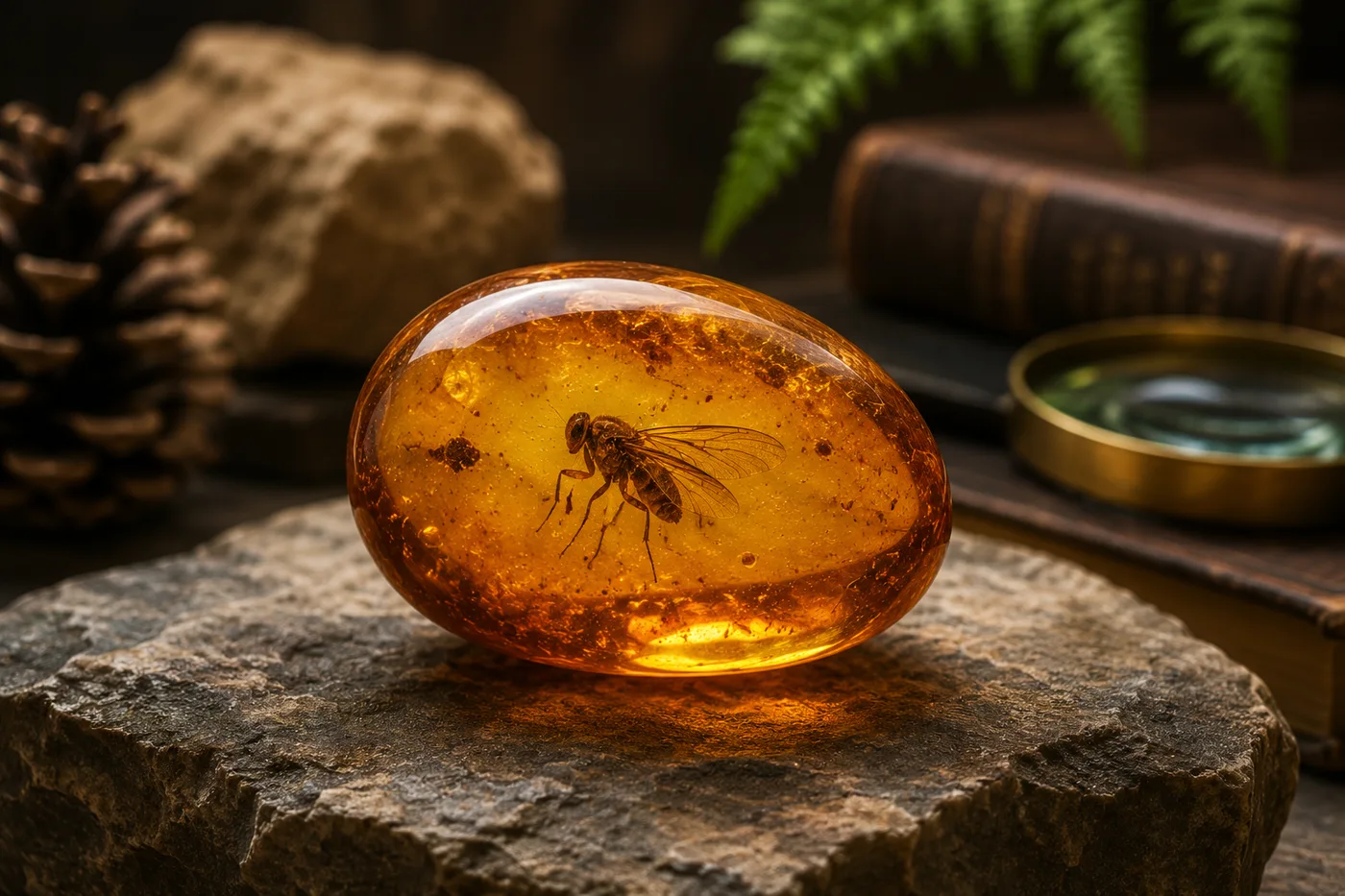
The short version: Amber has fascinated humans for at least 13,000 years, early Stone Age people in the Baltic region wore it as pendants long before they had a name for it. Today, when most people picture amber, they think of a tiny insect frozen inside a golden bead. That image owes a lot to a 1993 dinosaur blockbuster.
Amber has fascinated humans for at least 13,000 years, early Stone Age people in the Baltic region wore it as pendants long before they had a name for it. Today, when most people picture amber, they think of a tiny insect frozen inside a golden bead. That image owes a lot to a 1993 dinosaur blockbuster. But there's a real story behind it that's even older and stranger than the movie: the science of how a fragment of pine sap turns into a 100-million-year-old window into a vanished world.
How amber actually forms
Amber begins as resin, the sticky, sap-like substance that pine trees and other conifers produce when wounded. Resin protects the tree by sealing damage and trapping insects that might burrow into the bark. Most of it dissolves or rots away within a few years.
Occasionally, a chunk of resin falls into a place where it can be preserved: a forest floor that's about to be flooded, a layer of mud that will become sediment, or a peat bog. Over millions of years, that resin gets buried under more sediment. Pressure, heat, and the slow loss of volatile compounds turn it into a hard, stable polymer.
The process has a name, polymerisation, and a specific timeline. Resin that's only a few thousand to a few million years old is called "copal". It's softer and dissolves in solvents. Anything older than about 30 million years is true amber.
Why insects end up trapped (and why most don't)
When a beetle or mosquito landed on a sticky resin droplet, it usually had a small chance of escaping if the resin was warm and runny. Cold resin trapped them instantly. Sometimes a second wave of resin would flow over the trapped insect, sealing it completely from oxygen. That's the rare combination that produces the perfect specimens you see in museums.
Crucially, the trapped insect doesn't decompose normally. The resin dehydrates the soft tissue, locks out bacteria, and turns the body into an ancient mummy in miniature. In some cases, scientists have extracted DNA fragments, though not the long, intact strands needed for the a 1993 dinosaur blockbuster premise (sadly).
The reason real specimens are valuable: the conditions had to be right at exactly the right moment, and then the amber had to survive intact for tens of millions of years until someone dug it up. Less than 1% of natural amber contains visible insect inclusions of any kind.
Real vs. replica: a side-by-side
Real amber is a fossil. It has provenance (where it was mined), micro-imperfections (small fissures, gas bubbles, mineral inclusions), and a characteristic warm yellow-to-cognac colour that no resin can perfectly reproduce.
Resin replicas are made by suspending a 3D-printed or cast insect inside transparent polyester or epoxy resin, then polishing the result. The best replicas use UV-stable resin so they don't yellow over decades, and the inclusions are anatomically accurate down to the wing-vein pattern.
Both have a place. A genuine 99-million-year-old Burmese amber specimen with a mosquito inclusion costs $1,500–$8,000 for a small piece, and comes with ethical concerns about modern conflict mining. A high-quality resin replica costs $15–$40 and gives you the same conversation piece on your desk.
What to look for in a resin replica
Three things separate a good replica from a cheap novelty: clarity, the insect, and the finish.
Clarity: high-grade replicas use jeweller-quality polyester resin with no internal haze, no air bubbles around the inclusion, and no yellowing over time. Cheap versions go cloudy within months.
The insect: ask whether the inclusion is a printed 2D image embedded inside, a sculpted 3D figure, or a real preserved insect placed in resin. 3D sculpts are the gold standard for display, they catch light from any angle.
The finish: hand-polished pieces have smooth, slightly rounded edges and a glassy surface. Machine-finished pieces have visible tool marks. A wooden or stone base elevates a paperweight from "trinket" to "object you'd actually put on a shelf".
How to display a replica so it actually looks good
Backlighting transforms amber resin. A small puck light under the piece (or natural window light passing through it) makes the inclusion appear to float. Most VEOJEIN owners place pieces on a north-facing windowsill or near a desk lamp.
Pair the piece with a related object, a small natural-history book, a small succulent, a leather notebook. Single pieces look isolated; clustered pieces tell a story.
Avoid direct, prolonged sunlight on cheaper resin pieces. Premium UV-stable resin (what VEOJEIN uses) can sit in a sunny window for years; lower-grade resin yellows in 12–18 months.
A note on ethics
Most genuine Cretaceous-era amber with insect inclusions today comes from Hukawng Valley mines in Myanmar (Burma). These mines have a documented history of conflict financing and unsafe labour. Many natural-history museums have stopped acquiring new Burmese amber for that reason.
Baltic amber (Poland, Lithuania, Russia) is mined more transparently and is what you'll find in most jewellery. It's around 44 million years old and contains insect inclusions roughly 1/100th as often as Burmese amber.
Resin replicas don't have any of those ethical concerns. You're not extracting anything from a mine, you're not bidding against a museum, and the supply chain is clean.
Frequently asked questions
Is amber a stone?
No. Amber is fossilised tree resin, a polymer that hardened over tens of millions of years. It is much lighter than stone (it floats in salt water) and warm to the touch, more like plastic than mineral.
How old is real amber?
Most amber on the market is between 30 and 90 million years old. Baltic amber is around 44 million years old. Burmese amber (the famous mosquito-in-amber type) is roughly 99 million years old, genuinely from the Cretaceous period.
Are insects in amber rare?
Inclusions of insects, plant fragments, or feathers exist in roughly 1% of natural amber pieces, and most are millimetres across. Large, clearly visible inclusions of complete insects are very rare and command thousands of dollars at auction.
How can you tell amber from a resin replica?
Real amber smells faintly piney when warmed (touch it with a hot needle in a discreet spot); it floats in salty water; it builds static electricity when rubbed. Resin replicas are denser, optically clearer, and stay sharp under UV light.
Are VEOJEIN amber pieces real?
VEOJEIN amber-resin pieces are openly presented as premium resin replicas, museum-quality display objects, not fossils. They capture the look of insect-in-amber inclusions at a fraction of the price (and ethical concerns) of the real thing.