As an Amazon Associate, VEOJEIN earns from qualifying purchases made through links on this site. This never changes the price you pay.
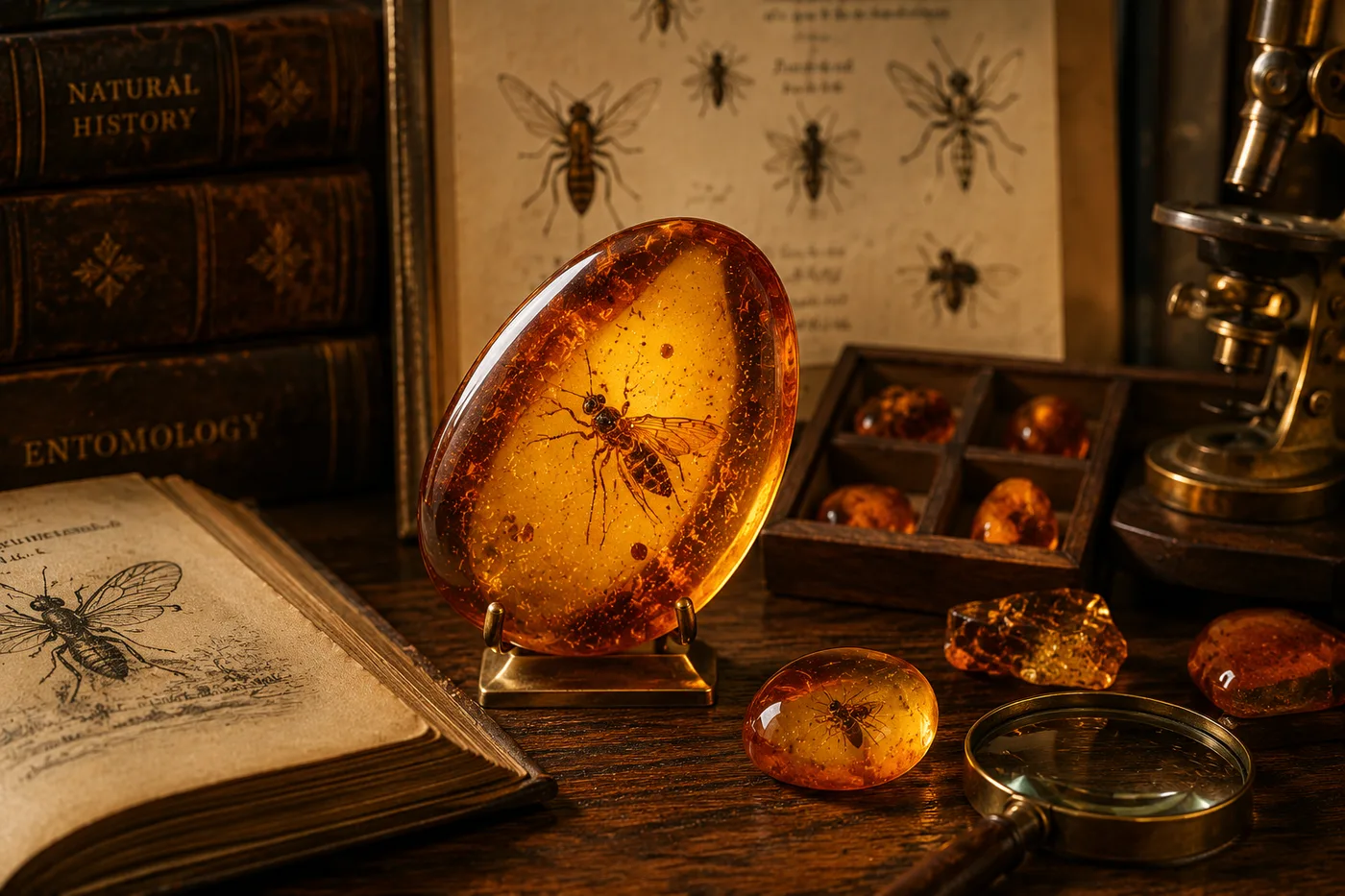
The short version: Long before humans had the word "fossil", we were finding insects inside golden stones. The Romans wore amber pendants. Bronze Age burial sites in northern Europe contain amber beads carved with care, often with a tiny preserved mosquito or fly visible inside.
Long before humans had the word "fossil", we were finding insects inside golden stones. The Romans wore amber pendants. Bronze Age burial sites in northern Europe contain amber beads carved with care, often with a tiny preserved mosquito or fly visible inside. The story of amber-trapped insects spans tens of millions of years of geology and at least 13,000 years of human fascination. This is the long version of that story, what science actually knows about how those insects got there, and why the specimens are so rare.
What resin had to do with bugs in the first place
Trees produce resin as a defence. When bark is wounded, by an insect borer, a falling branch, or fire, conifers and some flowering trees seal the wound with a thick, sticky liquid that flows down the trunk and hardens. The chemistry varies by species, but the function is consistent: it stops the wound from getting infected.
Most resin never becomes amber. It rots away within years, gets eaten by decomposers, or washes away in rain. The fraction that survives is the fraction that falls into a place where it can be buried quickly, a swamp, a riverbed, the floor of a forest about to be flooded. Bury it under sediment, give it 30+ million years, and the volatile compounds slowly evaporate while the polymer chains cross-link. The result is true amber.
Insects entered the story by accident. A fly landing on a fresh resin droplet usually escaped if the droplet was warm. Cold resin trapped them instantly. A second flow of resin over the trapped insect was the key step, it sealed them against decomposition for the long timescales required.
The geographic story: where amber comes from
Amber deposits cluster around the locations of ancient resin-producing forests. There are roughly six major sources, and the deposit determines the age and the typical inclusions.
Baltic amber, from coastal Poland and Lithuania, is the most familiar. It's around 44 million years old and comes from an extinct conifer (Pinus succinifera). The amber forms in coastal cliffs and washes up on beaches after storms. Baltic inclusions include flies, ants, beetles, spiders, and the occasional small lizard.
Dominican amber is younger, around 20-30 million years old, and clearer. It comes from a legume tree (Hymenaea protera). Inclusions tend to be more colourful because the resin was transparent and the colours of the insects are visible.
Burmese amber, the source of most famous "mosquito in amber" specimens, is the oldest commercial amber at roughly 99 million years. It comes from Myanmar's Hukawng Valley and contains Cretaceous-era life, including feathered dinosaur fragments, frogs, lizards, and a wider range of insect orders than any other deposit. The mining is also the most ethically problematic; see our guide on the ethics of the amber market.
What the inclusions tell us about ancient ecosystems
Inclusions are paleobiology's best record of small soft-bodied creatures. A mosquito doesn't fossilise, it dissolves. But an amber-trapped mosquito preserves wings, mouth parts, scale patterns, even gut contents.
From these specimens, scientists have reconstructed climates, identified extinct families, and tracked the evolution of social insects. A famous example: in 2017, paleontologists found a 99-million-year-old tick still gripping a feather from a small dinosaur. The specimen confirmed that ticks were feeding on dinosaurs the same way they feed on birds today.
Some inclusions show behaviour. A pair of ants frozen mid-fight. A spider holding a wrapped meal. A mosquito with the last meal still visible inside. These are snapshots of life from a vanished world, preserved by chance.
Why specimens are so rare (and so expensive)
For an insect to end up visible in modern amber, every one of these had to happen: it had to land on resin (not avoid the tree), it had to get fully covered (not flick out), the resin had to survive the next 100 million years without fracturing, and someone had to find and process the piece without destroying the inclusion.
Less than 1% of natural amber pieces contain visible insect inclusions of any size. Specimens with clearly identifiable insects are perhaps 1 in 1000. Specimens with a complete mosquito-in-amber inclusion, the iconic image, are auction-house material, selling for $1,500 to $8,000+ for a single small piece.
Resin replicas reproduce the look at a fraction of the cost and without the ethical issues of the modern amber trade. The best ones use anatomically accurate 3D sculpts of the insect, suspended in jeweller-grade resin. They're the right choice for display unless you're a specialist collector who needs the genuine article.
Where to see real specimens
If you want to see Cretaceous-era amber inclusions in person, four museums have major collections worth a trip: the American Museum of Natural History in New York, the Stuttgart State Museum of Natural History in Germany, the Geological Museum of Copenhagen, and the Smithsonian National Museum of Natural History in Washington DC.
Most museum displays are behind glass, in low light, with a magnifying lens beside the specimen. Bring a small flashlight to your visit, even where it isn't mounted, a side-light makes the inclusions much easier to see.
Frequently asked questions
How old are insects found in amber?
Most amber-trapped insects on the market are 40-100 million years old. Baltic amber inclusions are typically 44 million years old (Eocene era). Burmese amber from Myanmar is around 99 million years old, making it the oldest commonly available source, genuinely from the Cretaceous when dinosaurs walked.
Can you identify the species of an insect in amber?
Often yes. Paleoentomologists routinely identify amber-trapped insects to genus, and sometimes to species. The preservation is good enough to see wing venation, leg segmentation, and antennae detail, better than most fossils.
Is amber-trapped DNA usable?
Short fragments have been recovered from amber inclusions, but the DNA breaks down over millions of years. Reconstructing a complete genome from amber-trapped DNA, the cinematic dinosaur-cloning premise, isn't possible with current technology, and likely never will be.
What's the difference between a fossil and an amber inclusion?
A typical fossil is mineralised rock that preserves the outline of an organism. An amber inclusion preserves the actual 3D body inside transparent resin. Amber inclusions are more like a tiny ancient mummy than a fossil, soft tissue, hair, even gut contents can be visible.
Why are amber inclusions so rare?
Less than 1% of natural amber contains visible insect inclusions. The insect had to be small enough to be trapped, the resin had to seal it before predators or weather could disturb it, and the resin had to survive tens of millions of years intact. The combination of conditions is genuinely uncommon.