As an Amazon Associate, VEOJEIN earns from qualifying purchases made through links on this site. This never changes the price you pay.
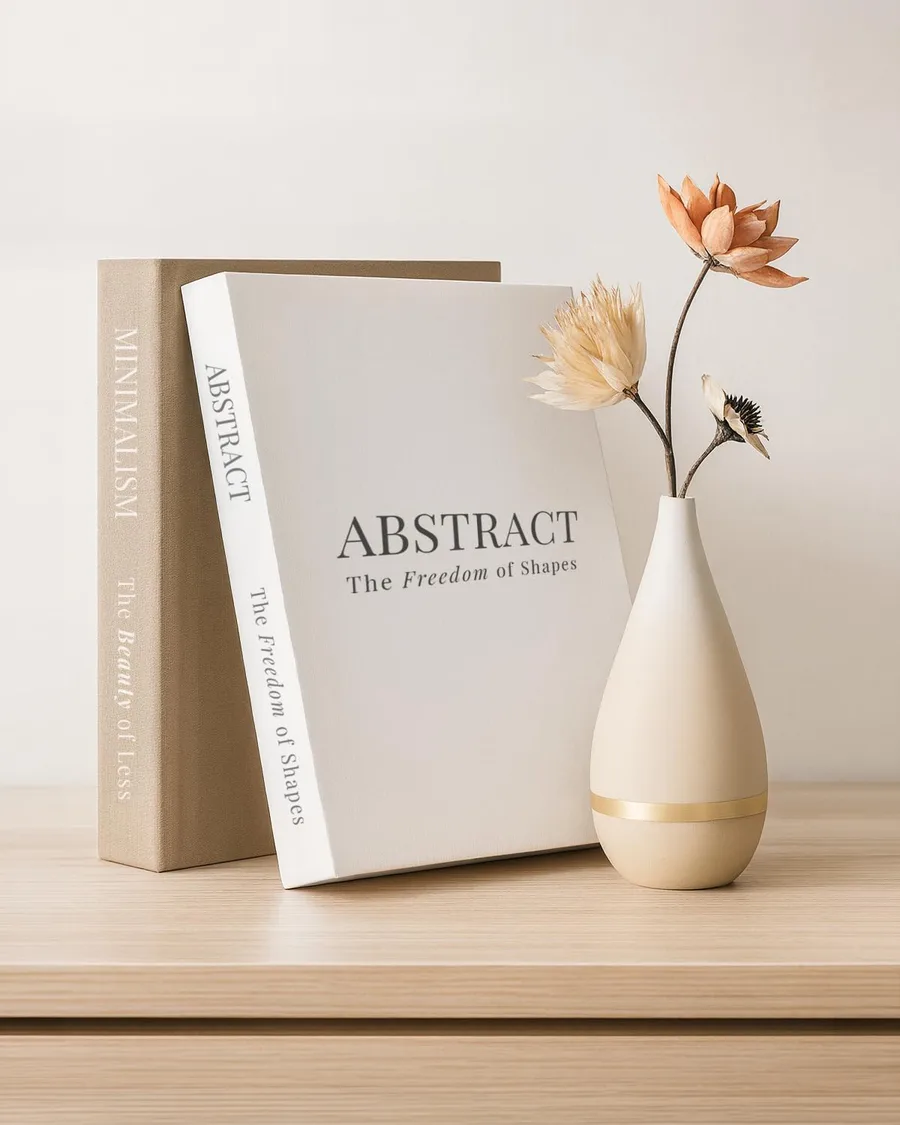
The short version: Aesthetic-only decorative book sets ($25 to $60) give you exact spine colors, consistent sizing, and a polished editorial look. Real books cost more variety but bring authenticity, varied weights, and the chance someone might actually read one. For staging or show-home contexts, aesthetic sets win. For lived-in shelves where the books are picked up, real books win. Most styled shelves use a mix.
Walk into any styled home on Instagram and you'll see books arranged on shelves with intent: stacked horizontally, leaned against each other, color-coordinated, topped with small objects. Most viewers assume these are real books the homeowner reads. Often they're not, they're aesthetic-only decorative book sets, sold blank, in muted spines designed specifically for shelf styling. The choice between real and decorative isn't ethics, it's tooling. Each one does a specific job. This guide walks through which job each one does best.
Decorative book sets: what they're optimized for
Decorative book sets are books made specifically for visual styling, not reading. The covers are cloth or linen-bound in muted designer palettes (sage, cream, dusty blue, cognac, smoky black). The interiors are typically blank or filled with placeholder text (sometimes copyright-free public-domain content so the book reads like a real book if cracked open).
What they're optimized for: spine color control (you pick the palette before ordering), consistent sizing within a set (all 5 books are the same height for clean stacking), no marketing branding on the cover (no Penguin Classics logo, no Random House watermark), low-cost coverage (a 5-book set typically runs $25 to $60).
Quality signals to look for: cloth or linen binding (not glossy paper), real embossed titles (not flat printed), consistent spine widths within a set, subtle palette tones (not jarring primary colors). Cheap aesthetic sets read as fake immediately, the spines are too uniform and the titles too placeholder-y. Quality ones could pass for a 1970s book collection at a glance.
Real books: what they bring that decoratives can't
Real books bring authenticity. Even if a guest never picks one up, real books have specific weight, varied spine wear, and visual specificity that decorative sets don't. A 1955 hardcover of 'The Way of All Flesh' has character; a brand-new decorative book in 'sage cloth' doesn't.
Strengths of real books: anyone can pick one up and have something to actually read, library cards or owner inscriptions add depth, spine wear builds character over years, the book can be a conversation starter (when a guest spots a familiar title), they cost variable amounts (free at library sales, $50+ for first editions).
Limits of real books: spine colors are whatever the publisher chose (you can't control palette), sizes vary (a mass-market paperback and a coffee-table book don't stack cleanly), titles can date a shelf (a 1990s self-help book among 2020s design titles looks off), and you have to physically acquire them (estate sales, used bookstores, your own collection).
Sourcing real books on a budget: used bookstores ($3 to $15 per book), estate sales ($1 to $5), library book sales (bagful for $5), thrift stores (hit or miss). The trick is shopping FOR a palette: bring a phone photo of the shelf you're styling and pick books that match the tones you want, not titles you want to read.
The side-by-side comparison
| Attribute | Decorative Set | Real Books |
|---|---|---|
| Typical cost (5 books) | $25 to $60 (set) | $5 to $200+ (depends on sourcing) |
| Spine color control | Exact (you pick) | None (publisher chose) |
| Size consistency | Identical within set | Varied |
| Authenticity signal | Low to medium | High |
| Conversation starter | No | Yes (recognizable titles) |
| Acquisition speed | 2-day Prime delivery | Weeks of shopping |
| Pet/kid resistance | More disposable | Risk to actual value |
| Reading value | None (blank inside) | Full |
| Best context | Show home, staging, accent shelf | Lived-in library, working desk, kids room |
The hybrid approach (what stylists actually do)
Almost no serious stylist uses ONLY decorative or ONLY real books on a primary shelf. The hybrid is the answer. A common ratio:
60 percent real books for character (visible spine variation, age, mixed sizes), 30 percent decorative books for palette discipline (the smaller stacks topped with objects, in muted spines), 10 percent objects (a candle, a small vase, a stone, a sculpture).
Placement strategy: real books fill the main shelves vertically (where the eye scans titles), decorative book stacks go horizontally on top of the verticals (the photographic 'flat stack with object on top' shot), books with the spine color you want most prominent get pushed forward to the shelf edge, the rest stay flush back.
What this looks like in practice: a 5-shelf bookcase with maybe 80 to 100 real books vertically across all shelves, 2 to 3 horizontal decorative stacks per shelf (3 books each, topped with a small object), and the whole thing reads as a curated working library, not a showroom or a hoarder pile.
When each one is actually wrong
Decorative-only is wrong when: the shelf is on a heavily-used wall (people will see the same fake spines for years), the household includes book readers or kids who'd actually grab a book, the room is a working library or home office, or your guests are bookish (they'll spot the trick immediately).
Real-only is wrong when: you're staging for sale (real personal books reveal too much about the seller), the bookcase is in a guest room or formal living room (no one's reading there, so the books are pure decoration anyway), or you've been collecting randomly for years and the palette is chaotic (too many bright spines, no visual rest).
Hybrid is wrong when: you're going for one specific extreme aesthetic. A radical minimalist room might use only 8 decorative books in identical cream spines. A radical scholar's office might use only real books with no concession to color. Both extremes have their place. The hybrid is just the most common middle path.
Frequently asked questions
Will guests notice if my books are decorative?
Bookish guests will notice within seconds (the spine colors are too coordinated, the titles too placeholder-y). Casual guests won't notice unless they pull one off the shelf. The cleaner the home, the more decorative becomes acceptable; the more book-loving the household, the more obvious decorative sets look.
Can I write inside decorative books?
Most have blank pages or copyright-free filler text. You can absolutely write notes, lists, or journal entries inside them. Some people turn aesthetic books into functional journals or sketchbooks, which is a great use.
What's the most overrated thing about decorative books?
The idea that all books in a styled shelf need to be the same palette. They don't. Two or three contrasting books in the same shelf add depth. Total palette uniformity reads as a showroom.
How do designers source the 'aged' decorative books I see in magazines?
Most are real vintage books from estate sales and library auctions. The 'aged decorative' aesthetic isn't really achievable from a brand-new set, the binding is too crisp. Mix 1 to 2 real vintage books into a decorative set for the effect.
Are decorative books a waste of money?
If you spend $300 on a 50-book set just for one shelf, yes. If you spend $40 on a 5-book set to anchor a styling moment that's been bothering you for months, no. The trick is using them as accents, not as your whole library.