As an Amazon Associate, VEOJEIN earns from qualifying purchases made through links on this site. This never changes the price you pay.
The short version: If someone you love is into fossils, dinosaurs, or the deep past, the gift problem is real. The bookstore section is small. The toy options are aimed at children. Most adult fans end up with a desk that's full of well-meaning but slightly embarrassing dinosaur figurines from people who didn't know what to get them.
If someone you love is into fossils, dinosaurs, or the deep past, the gift problem is real. The bookstore section is small. The toy options are aimed at children. Most adult fans end up with a desk that's full of well-meaning but slightly embarrassing dinosaur figurines from people who didn't know what to get them. Here are 10 better gifts, all under $50, that an adult paleontology enthusiast will actually want to display.
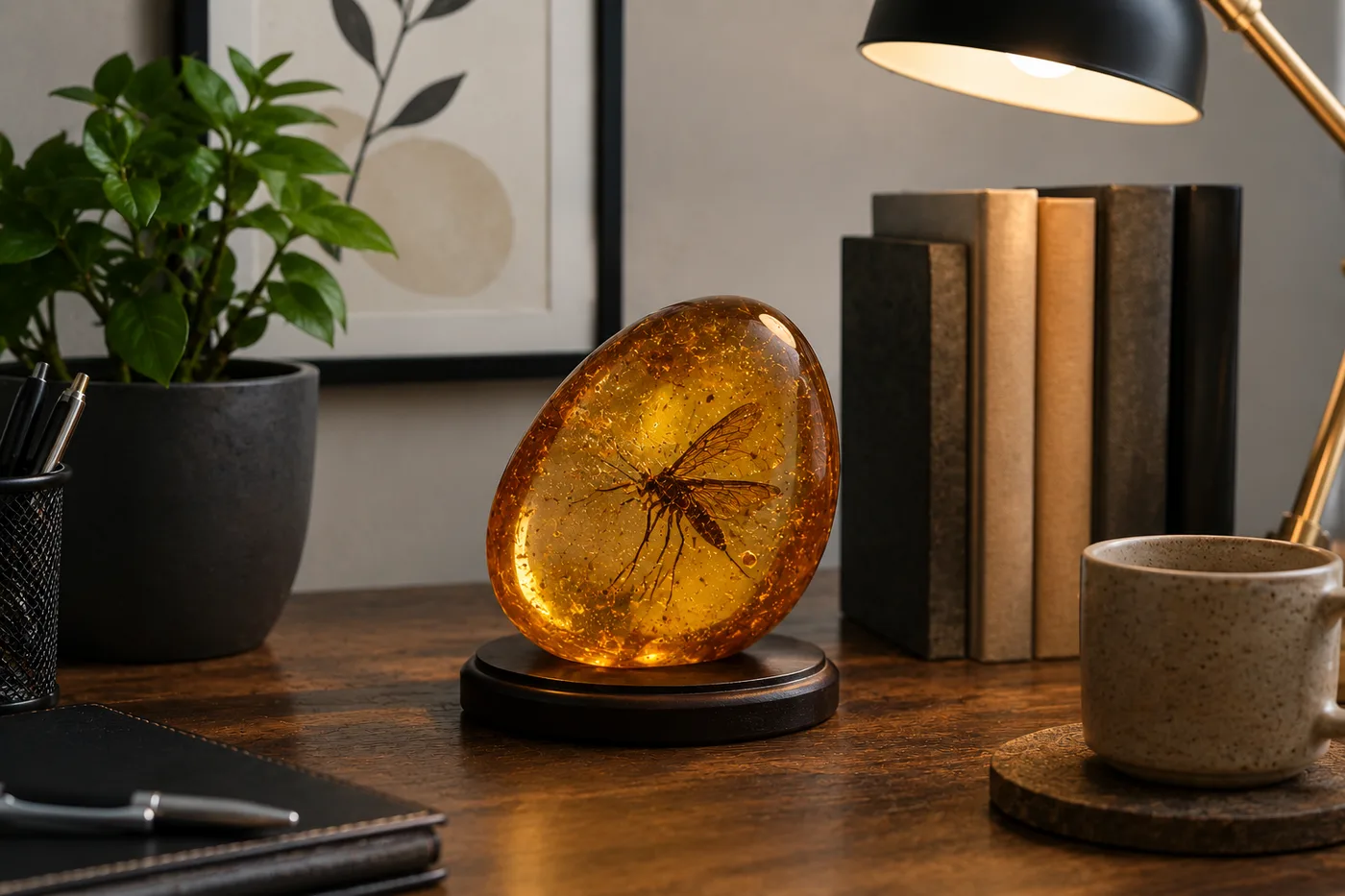
1. A mosquito-in-amber paperweight
It's the most recognisable fossil-related object in popular culture, courtesy of a 1993 dinosaur blockbuster. A high-quality resin replica with a sculpted 3D mosquito inside, not a flat printed image, sits on a desk as a permanent reference to the film, the science, and the gift-giver who clearly thought about it.
Look for amber-coloured polyester resin with a flat or wooden base, around 3 inches tall. Avoid pieces with bubbles around the insect (cheap casting) or pieces where the mosquito is clearly a 2D printed image. Price range: $15–$40.
2. A dinosaur footprint replica
Cast from an actual fossilised track, a dinosaur footprint replica is a 10-inch slab of resin or composite that looks exactly like a museum specimen. Hang it on the wall or use it as a desk tray for keys, coins, and small items.
The Cretaceous theropod footprint is the most recognisable design, three forward-pointing toes with claws. T-Rex footprints are popular but less anatomically accurate in cheap versions. Look for hand-finished pieces with visible texture, not smooth resin. Price range: $20–$45.
3. A serious book about deep time
A coffee-table book or readable popular science title beats a fictional dinosaur novel for most adult enthusiasts.
Recommendations that won't feel cliché: Steve Brusatte's "The Rise and Fall of the dinosaurs" (paleobiology for adults), Riley Black's "The Last Days of the Dinosaurs" (the extinction event hour-by-hour), or anything from the Princeton Field Guide series.
Pair the book with a $5 bookmark and a coffee subscription if you're inclined toward gift sets. Price range: $15–$35.
4. A polished ammonite fossil
Ammonites are extinct sea creatures (relatives of squid) whose spiral shells fossilised beautifully. A polished ammonite is small enough for a shelf, geologically real, and ethically mined in bulk from Morocco. Many adult paleontology fans don't have a real fossil, this is a gateway piece.
Look for pieces 2–4 inches across, polished to a high shine on one side with visible spiral chambers. Skip pieces that are dyed or have unnaturally bright colours. Price range: $10–$30.
5. A field guide to local rocks and fossils
If the recipient lives somewhere with a meaningful geological story (the American West, the Jurassic Coast in England, the Cliffs of Dover), a regional field guide turns every walk into a possible discovery.
These are usually paperback, well-illustrated, and under $20. Pair with a small geological hammer or hand lens if you want to make it a starter kit. Price range: $10–$25 for the guide, $35–$50 for a kit.
6. A fossil display jar with a small specimen inside
A small resin or glass jar with a real shark tooth, fossilised fern, or small ammonite inside reads more like a curated specimen than a souvenir. It's a desk object, not a toy.
The best versions have a vintage-feeling label or a brass plaque identifying the specimen. Price range: $15–$40.
7. A natural-history print or art piece
A framed scientific illustration of a fossil specimen, a dinosaur skeleton, or an extinct creature is a wall version of the same impulse, natural history as decoration.
Etsy and several museum shops sell beautiful Victorian-era reproduction prints starting at $15. Frame it in a thin black or oak frame and you have a $30–$50 gift that fills a wall.
8. A subscription to a natural-history magazine
Most people don't subscribe to print magazines anymore, which is exactly why receiving one as a gift feels personal. Smithsonian, National Geographic History, and Natural History magazine all publish thoughtful fossil and paleontology coverage.
Annual subscriptions run $20–$40. Pair with a single back issue you already have in your hand so they get something tangible to open. Price range: $20–$50.
9. A specimen-grade rock (not a fossil)
Sometimes the geology nerds in paleontology fans want a beautiful rock instead of a fossil. A polished slice of agate, a chunk of pyrite cube, or a desert rose gypsum sells for $10–$30 and sits on a desk for life.
These pair beautifully next to a fossil replica, different aesthetics, same "deep time on my desk" sensibility.
10. A dinosaur skeleton paperweight or sculpture
A 4–6 inch resin or metal T-Rex skeleton, mounted on a small base, is the unexpected adult version of a child's dinosaur toy. It looks like something from a museum gift shop, which is exactly the right reference.
The trick is staying away from anything painted in bright colours or cartoon-styled. The good versions are monochrome (bronze, black, or dark grey) and capture the actual skeletal anatomy. Price range: $25–$50.
How to wrap and present
Skip generic gift bags. Wrap fossil-related gifts in unbleached kraft paper with a single strand of twine. The earthy, dug-up feeling matches the gift category.
Include a small handwritten card that says one sentence, what you noticed about them that made this the right gift. "I remembered you said you wanted to go to the Smithsonian's dinosaur hall" lands harder than "Happy birthday".
If you're giving a fossil replica with a a 1993 dinosaur blockbuster reference, you can lean into the cheekiness. Print the card on a slip of yellow legal pad paper for the "InGen field notes" vibe. Most people get the joke.
Frequently asked questions
What's a good gift for a 1993-dinosaur-film superfan?
The mosquito-in-amber paperweight is a direct, recognisable reference and works as both a desk decoration and a conversation piece. Pair it with a hardcover edition of Michael Crichton's original novel for a thoughtful gift set under $50.
Are fossil replicas a good gift for kids?
Yes, but for older kids (10+) who want "the real thing" feel. Younger kids prefer brightly coloured plastic dinosaurs. Resin replicas are durable but should be supervised because they're heavier than they look.
Where do real fossils come from for gifts?
Genuine fossils for the gift market are usually fish (from Wyoming's Green River formation) or small ammonites (from Morocco). They're inexpensive and ethically mined. Larger fossils have provenance concerns.
What's the difference between a fossil and a fossil replica?
A fossil is the actual mineralised remains of an organism, millions of years old. A fossil replica is a modern cast or sculpture that recreates the appearance. Replicas cost 10–100× less and have no preservation or ethical concerns.