As an Amazon Associate, VEOJEIN earns from qualifying purchases made through links on this site. This never changes the price you pay.
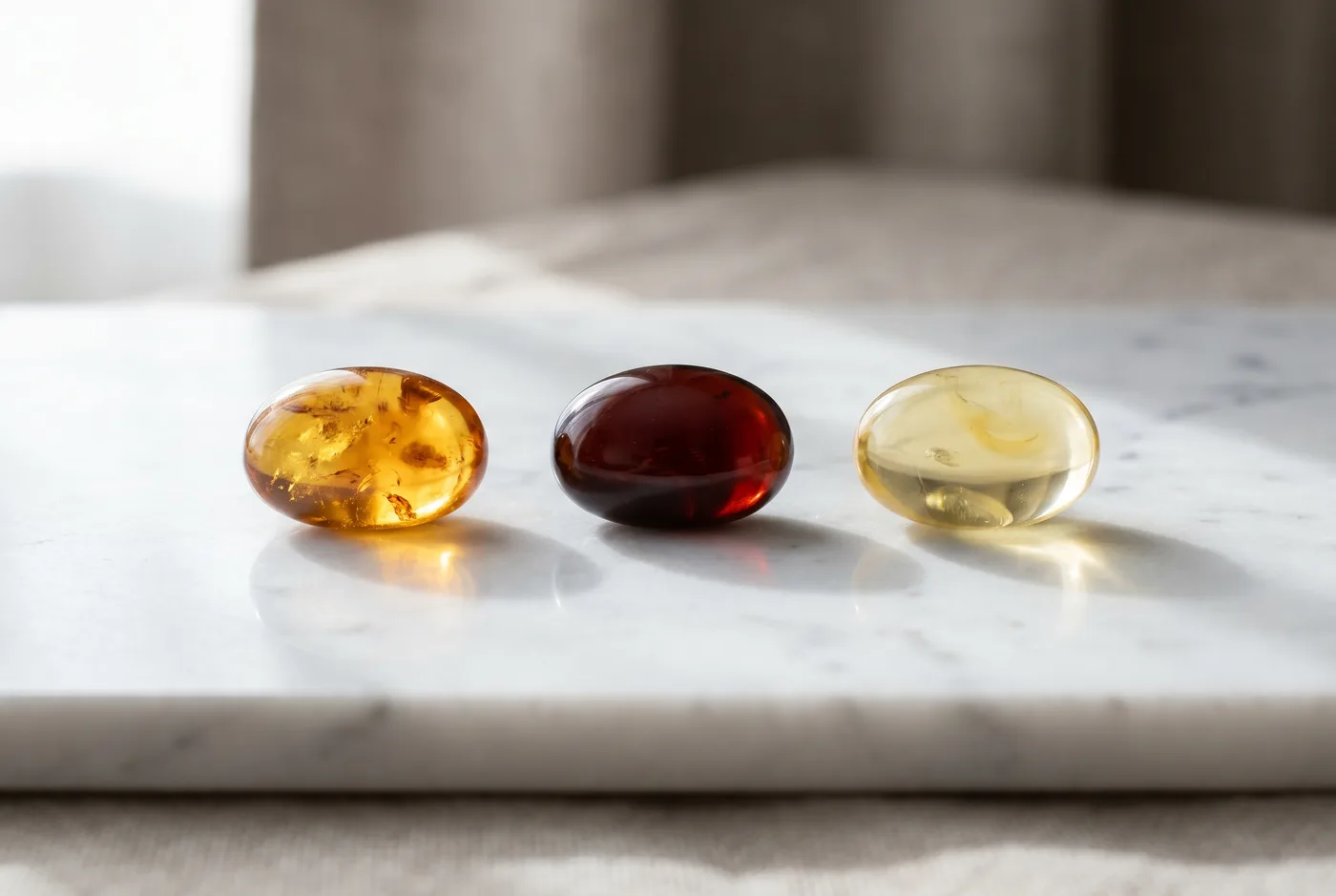
The short version: Baltic amber is the mainstream ethical choice: 30-50 million years old, mostly honey to cognac, well-regulated supply. Dominican amber is younger (15-20 million years) and often clear, sometimes blue or green. Burmese amber is the oldest commercial amber (99 million years) with the richest inclusions, but mining conditions raise serious ethical concerns. Pick Baltic for general collecting, Dominican for specific colors, Burmese only with documented provenance.
If you're buying real fossil amber, the first decision isn't color or size. It's origin. The three main commercial sources, Baltic, Burmese, and Dominican, have wildly different ages, colors, ethics, and prices. A piece labeled simply 'amber' on a marketplace might be any of them, with no way for the buyer to tell. This guide compares them on what actually matters: where they come from, what they look like, what's inside, what they cost, and which ethical issues each one carries.
Baltic amber: the mainstream choice
Baltic amber comes from the Baltic Sea region, primarily Poland, Lithuania, Russia (Kaliningrad), and Latvia. It's the most-mined commercial amber on the market, with the longest documented trade history (4,000+ years of recorded use).
Age: 30 to 50 million years old, from Eocene-era forests. Colors run from pale lemon to deep cognac, with honey being most common. Roughly 90 percent of jewelry and museum amber in Europe is Baltic.
Inclusions are common but typically smaller invertebrates: ants, midges, spiders, the occasional small wasp. Larger vertebrate inclusions are rare in Baltic amber.
Mining is regulated, mostly mechanized, and (by amber standards) ethically clean. Kaliningrad supplies the most volume but with documented labor issues; Polish and Lithuanian sources are considered the cleanest.
Pricing: a 1-inch piece with a visible insect typically runs $40 to $200 retail. Without inclusion, $15 to $80.
Burmese amber: oldest and most ethically complicated
Burmese amber, also called 'burmite,' comes from Myanmar's Hukawng Valley. At roughly 99 million years old, it's the oldest commercially available amber, dating to the mid-Cretaceous, the heart of the dinosaur era.
Colors range from cherry-red to dark cognac to deep brown, with occasional rare cobalt-blue specimens. The age means the resin has been compressed and partly transformed, giving it a darker, denser appearance than younger ambers.
Inclusions are the most paleontologically valuable in the world: tiny feathered dinosaurs, ancient lizards, complete frogs, hundreds of insect species not found in any other deposit. This is why museum researchers prize Burmese amber.
The mining situation is the issue. Hukawng Valley mining has been linked to forced labor, conflict-funding, and worker safety concerns documented by the UN and international watchdogs. Most major scientific journals (including major paleontology journals) now refuse to publish research on Burmese amber sourced after 2017 due to provenance concerns.
Pricing: starts higher (~$100 for tiny chips) and goes much higher (museum-grade Burmese with vertebrate inclusion: $5,000 to $50,000+). If you're considering Burmese, demand pre-2017 provenance documentation.
Dominican amber: youngest and clearest
Dominican amber comes from the Dominican Republic, primarily Cordillera Septentrional. At 15 to 20 million years old, it's the youngest commercial amber, from Miocene-era tropical forests.
Colors are typically clear honey to clear cognac, with notable rarities: blue amber (caused by fluorescent compounds) and green amber are nearly unique to Dominican deposits. Blue Dominican amber under sunlight has an almost otherworldly look.
Inclusions are common and well-preserved: tropical insects, the occasional small lizard or frog. The younger age means inclusions are often more 'lifelike' in appearance, since less time has passed for distortion.
Mining is mostly small-scale artisanal, performed in tunnels by individual miners. Working conditions vary by mine, generally better than Burmese but with their own concerns. Supply is limited and dwindling, which keeps prices firm.
Pricing: a 1-inch clear Dominican honey piece runs $50 to $250 retail. Blue or green Dominican: $200 to $1,000+ for the same size.
The side-by-side comparison
| Attribute | Baltic | Burmese | Dominican |
|---|---|---|---|
| Age (millions of years) | 30 to 50 | ~99 | 15 to 20 |
| Typical color | Honey, cognac, lemon | Cherry, dark cognac | Clear honey, rare blue/green |
| Inclusion variety | Small invertebrates | Best in the world (vertebrates possible) | Tropical insects, lizards |
| Supply volume | High | Medium (declining) | Low |
| Mining ethics | Clean to moderate | Serious concerns | Mixed, varies by mine |
| Price (1-inch piece, no inclusion) | $15-80 | $100-500 | $50-250 |
| Price (1-inch with visible inclusion) | $40-200 | $300-5,000+ | $80-1,000 |
| Best use case | General collecting, jewelry | Museum, dinosaur enthusiasts (with provenance only) | Specific colors (blue/green), unique displays |
| Ease of authentication | Easy, plenty of references | Harder, fakes common | Medium |
| Buy this if you want | Reliable, ethical, mid-priced amber | Cretaceous-era amber (and have provenance) | Rare colors or tropical inclusions |
Which to buy: the simple decision tree
If you're buying your first piece: Baltic. It's the safest entry point. Supply is reliable, price is reasonable, fakes are easy to spot. Most first-time amber buyers should choose Baltic and not look further.
If you specifically want a blue or green amber: Dominican. No other source produces these colors reliably. Expect to pay $150 to $500 for a small piece.
If you specifically want Cretaceous-age dinosaur-era amber: Burmese, but ONLY with pre-2017 provenance documentation from a reputable dealer. Without provenance, walk away. The ethical concerns are real, and supporting unethical mining isn't worth any inclusion.
If you want a display piece for under $50: skip real amber entirely and buy quality cast resin. There's no shame in this. Read our amber resin vs real amber comparison for the trade-offs.
Frequently asked questions
How do I verify Burmese amber is pre-2017?
Ask the seller for a provenance document or invoice predating 2017, or buy from established museum-deaccession sources. Most reputable dealers can provide this; if they can't, it's almost certainly post-2017 stock.
Is Dominican blue amber real or treated?
Both exist. Genuine Dominican blue amber gets its color from fluorescent compounds (perylene). Treated 'blue' amber is honey amber dyed or heat-treated. Real blue Dominican fluoresces under UV and shows the blue color most intensely under sunlight. Treated pieces look more uniform and less luminous.
Why is Burmese amber illegal to publish about?
It's not illegal, but most major paleontology journals voluntarily refuse Burmese amber papers sourced after 2017 because of forced-labor concerns in the Hukawng Valley. Some independent researchers continue to publish, but the field consensus has shifted.
Can I tell amber origin from a photo?
Sometimes. Color is a strong hint (clear honey often Dominican, deep cherry often Burmese, cognac-honey often Baltic). But the only reliable tests are physical inspection (UV fluorescence pattern), chemical analysis (succinic acid percentage), and provenance documentation.
Which amber appreciates most in value?
Real Burmese amber with documented pre-2017 provenance and significant inclusions has appreciated most over the past decade. Baltic amber appreciates slowly (3 to 5 percent per year for collector grades). Dominican holds value due to limited supply. Cast resin doesn't appreciate.