As an Amazon Associate, VEOJEIN earns from qualifying purchases made through links on this site. This never changes the price you pay.
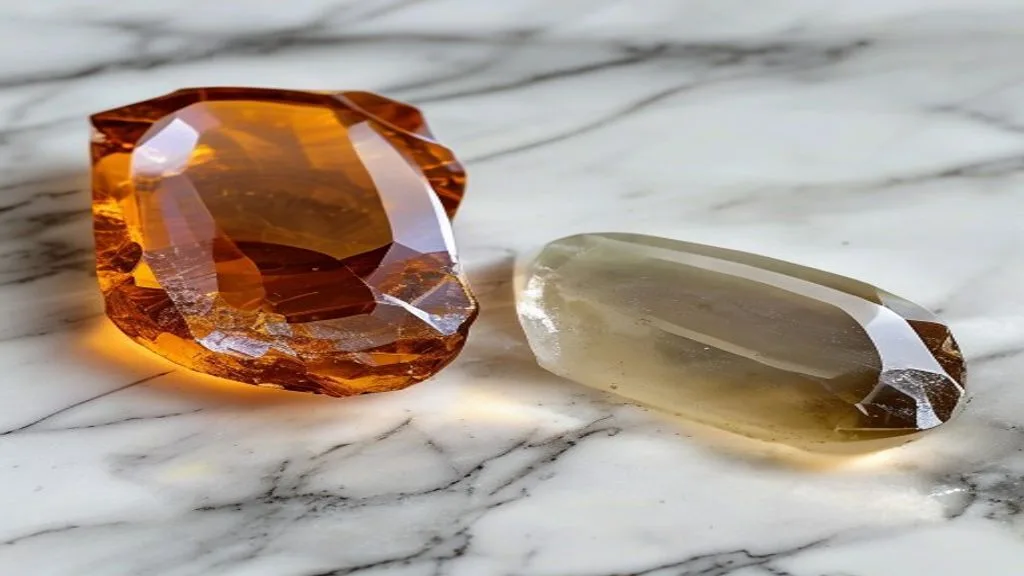
The short version: Real amber is 30-90 million-year-old fossilized tree resin, typically priced $30-500+. Amber resin is modern polyester or epoxy resin cast in amber tones, typically $10-50, sold honestly as a replica. Both work as display pieces, but only one is fossil. Real amber is heavier, warmer to touch, fluoresces blue under UV. Resin is uniform, more durable, easier to display.
When you search 'amber paperweight' online, you'll find prices ranging from $12 to $600. The cheap ones aren't fake amber, they're amber RESIN, a modern cast-resin product that imitates the look without being fossilized. Most online shoppers don't know the difference, and most listings don't explain. This guide walks through what's actually different between fossil amber and amber resin, when each makes sense, and how to tell which you're looking at without a lab.
What real amber actually is
Real amber is fossilized tree resin, specifically resin that hardened, was buried in sediment, and underwent millions of years of slow polymerization. Most commercial amber on the market today is between 30 and 90 million years old, originating from Baltic, Dominican, Burmese, or Mexican deposits.
Real amber has specific physical properties: a specific gravity of about 1.05 (it floats in salty water but sinks in fresh), a melting point around 250 to 300 degrees C, and it fluoresces blue-green under UV light. When rubbed against wool, it builds a static charge strong enough to lift a small paper scrap. These are all consequences of its actual chemical composition, succinic acid and complex hydrocarbons that wouldn't exist in any modern resin.
Real amber is also fragile. It scratches with a steel knife. It cracks if dropped on stone. It oxidizes slowly over decades, darkening at the surface. These aren't defects, they're the marks of a real fossil.
What amber resin actually is
Amber resin is a modern cast-resin product: typically polyester resin or epoxy, sometimes acrylic, tinted with amber-colored pigments and often cast around a small inclusion (insect-shaped, leaf-shaped, or generic 'flake' inclusion).
The process is straightforward. Liquid resin gets mixed with hardener and pigments, poured into a mold around the inclusion, cured at room temperature or in a low-temperature oven, then demolded and polished. Quality cast resin pieces are made by skilled artisans and can take hours to finish; cheap ones come off an assembly line in seconds.
Amber resin has its own properties: heavier than amber (specific gravity around 1.2 for polyester resin), much higher melting point (200+ degrees C for epoxy, can resist a hot pan briefly), no UV fluorescence, no static charge, doesn't oxidize. Quality resin is chemically stable for 50+ years indoors. It's actually more durable than real amber for display purposes.
The side-by-side comparison
| Attribute | Real Amber | Amber Resin |
|---|---|---|
| Age | 30 to 90 million years | Made this year |
| Typical price (paperweight) | $60 to $500+ | $12 to $50 |
| Density | Light, 1.05 g/cm3 | Heavier, 1.2 g/cm3 |
| UV fluorescence | Yes, blue-green | No |
| Static charge when rubbed | Yes | No |
| Smell when heated | Pine, resinous | Plastic, chemical |
| Scratch resistance | Soft, scratches at Mohs 2-3 | Harder, Mohs 3-4 |
| Inclusion authenticity | Genuine ancient insect or plant | Modern insect or 3D-printed inclusion |
| Long-term stability | Oxidizes over decades | Stable indoors 50+ years |
| Display use | Excellent, irreplaceable | Excellent, replaceable |
| Best for | Collectors, gifts of meaning | Display, kids, anyone on budget |
Which to buy for which use case
Buy real amber if: you're collecting, the piece is a serious gift (anniversary, milestone), you want something that will outlast you, you're a paleontology enthusiast who values authenticity over uniformity, you have at least $80-100 to spend on a small piece, and you accept fragility as a trade-off.
Buy amber resin if: you want the visual effect at a fraction of the cost, you want display reliability (won't crack if knocked over), you want a uniform appearance for matching pieces, you're buying for a child's room or a high-traffic shelf, you want a Jurassic-Park-style mosquito-in-amber piece for under $40, or you want a paperweight that survives accidental coffee spills.
There's no shame in either choice. Quality cast resin pieces are honest replicas, often artist-made, and they look exactly like the cinema-prop amber that made people fall in love with the concept in the first place. The mistake is buying resin while thinking it's fossil. Buy with eyes open and either makes sense.
How to tell which you're holding
Five quick tests you can do at home without lab equipment:
1. UV light test. Shine a blacklight on the piece. Real amber glows blue-green where the light hits it. Cast resin doesn't.
2. Static test. Rub the piece firmly on a wool sweater for 20 seconds, then bring it close to a torn paper scrap. Real amber picks up the scrap from a few millimeters away. Resin doesn't.
3. Float test. Mix 2 tablespoons of salt into a cup of warm water. Real amber floats. Most cast resins sink. Note: this test is destructive to wood bases, so only test loose pieces.
4. Hot needle test (only on inconspicuous spots). A red-hot needle pressed gently into real amber smells of pine. Cast resin smells of plastic. This test leaves a small mark.
5. Cost test. If you paid less than $30 for a 3-inch piece, it is essentially guaranteed to be resin. Real fossil amber that size simply doesn't exist at that price.
Bonus: if the listing includes the phrase 'amber resin' or 'cast resin replica,' you're being told upfront. That's the honest end of the market. VEOJEIN sells resin pieces and is explicit about it on every product page.
Frequently asked questions
Is amber resin the same as fake amber?
Yes, in the sense that it's not fossil amber. No, in the sense that quality resin is a legitimate cast product, not a deceptive imitation. The deception only happens when sellers label resin as 'genuine amber' instead of 'amber-style resin' or 'amber resin replica'.
Will amber resin last as long as real amber?
Indoor display: yes, easily 50+ years. UV outdoor exposure: no, cheap resin yellows in 1 to 3 years. Real amber outlasts cast resin only outdoors, and even then both should be displayed inside.
Can I use the inclusion in amber resin for science?
No. The insects or leaves in cast resin are typically modern specimens (or 3D printed lookalikes), not ancient. They have no paleontological value. They're decorative only.
Why is real amber so much more expensive?
Three reasons: scarcity (fossil deposits are limited and finite), mining/extraction cost, and authentication. Real amber pieces with genuine inclusions get authenticated by gemologists, which adds 30-50 percent to the price.
Is buying amber resin ethical?
Yes. There are no ethical concerns with cast resin production. By contrast, real Burmese amber (the source of most museum-grade specimens) has significant ethical issues tied to mining conditions and conflict regions. For ethical concerns specifically, see our amber market ethics guide.