As an Amazon Associate, VEOJEIN earns from qualifying purchases made through links on this site. This never changes the price you pay.
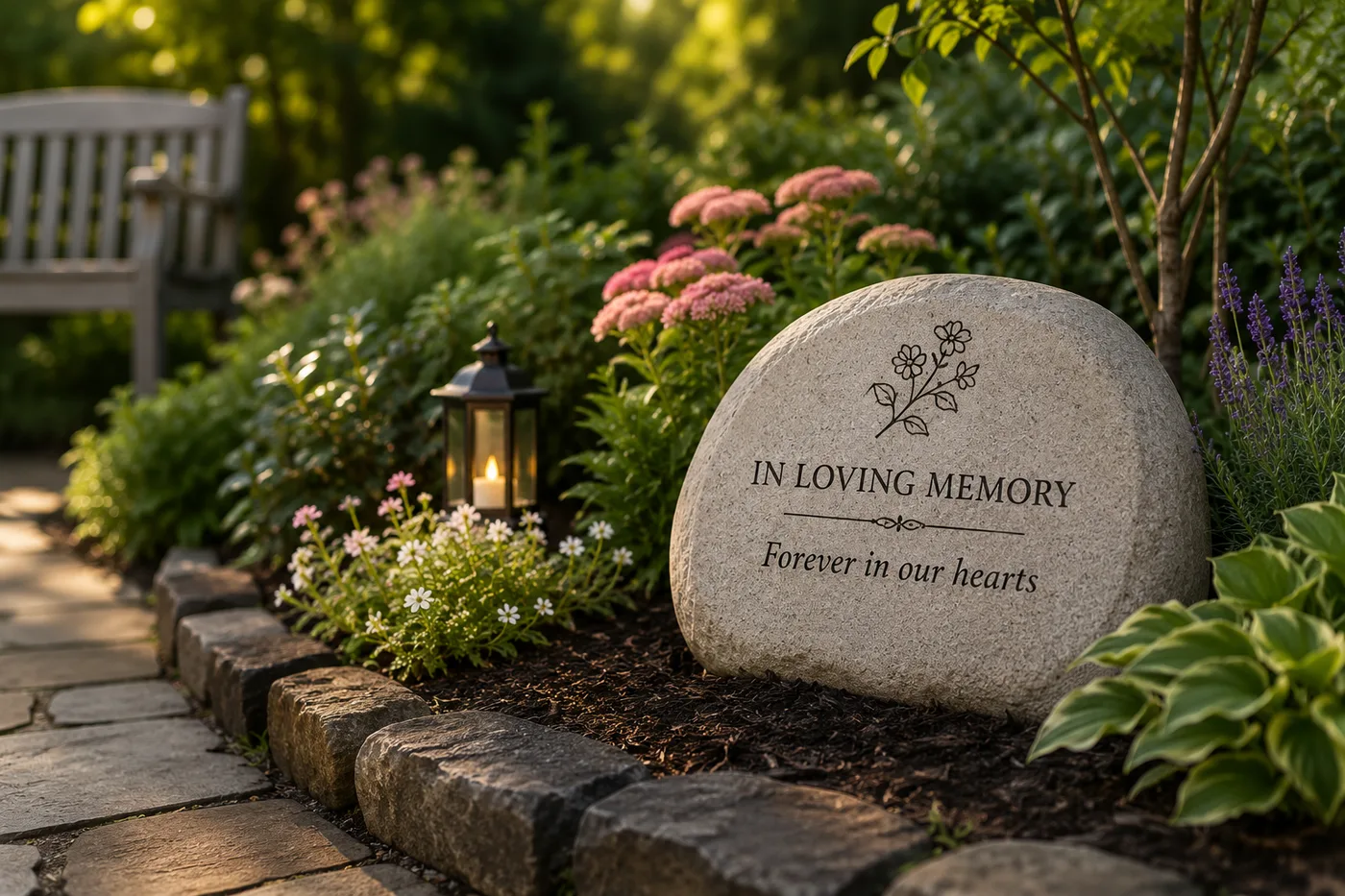
The short version: Memorial garden stones are one of the most personal objects you can give. They sit outside in the rain and the sun for decades, holding a name or a message that means something. Getting the choice right matters, and there's more to it than picking the design you like.
Memorial garden stones are one of the most personal objects you can give. They sit outside in the rain and the sun for decades, holding a name or a message that means something. Getting the choice right matters, and there's more to it than picking the design you like. This guide covers material, size, weather durability, engraving longevity, placement, and the etiquette around giving one as a gift.
Material: what lasts outdoors
There are essentially three material categories for garden stones, and they trade off durability, weight, and price.
Polyresin composite is the most common today. It's a polymer mixed with stone powder, cast into a mould, then hand-painted or engraved. The good versions are weatherproof, frost-resistant, and last a decade or more outdoors with no maintenance. The cheap versions are hollow plastic painted to look like stone, avoid these.
Cast concrete or concrete-resin is heavier and more traditional-looking. It survives freeze-thaw cycles well, but unsealed concrete can stain from leaf tannins over years. Sealed concrete is fine.
Natural stone (granite, marble, slate) is the most durable and the most expensive. Engraving holds for generations. The downside is weight, a 12-inch granite stone is genuinely heavy, and shipping costs reflect that.
Size and weight
The most popular size is around 9.45 inches in diameter, large enough that the design is clear from a path, small enough to tuck near a flower bed or under a tree.
Anything smaller than 7 inches gets visually lost in mulch or grass. Anything larger than 14 inches starts to feel like a grave marker, which some recipients won't want.
Round stones feel softer and more decorative. Rectangular stones feel more like markers. For memorial use, round is usually the kinder choice unless the recipient specifically asked for a marker shape.
Engraving and design longevity
Three engraving methods, ranked by longevity:
Carved-and-painted: the design is recessed into the surface, then painted. The paint sits in the recess and is protected from rain and wind. Lasts 5+ years even in harsh weather.
Surface-painted: the design is hand-painted directly onto the stone surface. Beautiful initially, but exposed paint chips and fades. Lasts 1–3 years in direct sun.
True engraving / laser etching: the design is cut into the stone itself with no paint at all. Doesn't fade, ever, but the design is more subtle, often relying on shadow rather than colour contrast.
For most memorial uses, carved-and-painted is the sweet spot. Designs stay readable for years, and the colour adds warmth that pure engraving lacks.
Placement: where to put it
Most memorial stones live in one of three places: along a garden path where it's seen daily; under a tree the recipient associates with the person or pet; or in a flower bed that becomes a small memorial corner.
Avoid full sun all day if the stone is hand-painted, UV ages paint faster than weather does. Partial shade extends the life of the colours.
Anchor it. A 9-inch stone sitting on grass can shift over winter or get bumped by lawnmowers. Set it on a level patch of compacted gravel or stone-dust to keep it stable and visible.
Designs that work (and ones that don't)
Designs with broad emotional resonance work best as gifts: family tree of life motifs, angels, birds, gardens of flowers. They speak to many situations, the loss of a parent, a grandparent, a pet, or simply a reminder of someone who matters.
Designs that are very specific to one tradition (a particular religious symbol, a sports team logo) can feel narrower. Use them only when you're certain the recipient identifies with that tradition.
Avoid designs that look generic or mass-produced, they undermine the personal weight of the gift. A hand-painted bird with visible brush detail reads as thoughtful; a flat printed design reads as a corporate sympathy card.
Etiquette when giving a memorial stone
Memorial stones are a quiet, considered gift. They're best given one-on-one, not at group celebrations or as part of a holiday gift pile.
Skip the flowers. Flowers and a memorial stone together send a funeral signal that the recipient may not want. A small handwritten note explaining why you thought of them is enough.
Don't include the recipient in the design choice unless they want to be. Most people would rather receive a stone you chose with care than be asked to specify how they'd like their grief commemorated.
Be ready for an emotional reaction. The gift may bring tears the moment it's unwrapped, that's almost always a good sign. It means the gift landed.
Frequently asked questions
What size memorial garden stone is best?
Stepping-stone size (around 9–10 inches across) is the most versatile, large enough to read from a few feet away, small enough to find a spot for in any garden. Smaller (under 8 inches) tends to disappear in foliage; larger (over 14 inches) starts to look like a marker, which not everyone wants.
Do garden stones survive winter freezes?
High-quality resin and concrete-resin composites handle freeze-thaw cycles fine. Pure stone (granite, marble) is also durable but expensive. Avoid hollow plastic, water seeps in and cracks it the first winter.
Will the engraving or paint fade?
Premium pieces use UV-stable inks or carved designs that won't fade for 5+ years. Cheaper hand-painted designs fade in one season of direct sun. Look for "weather-resistant" or "UV-stable" in the description.
Is a memorial stone an appropriate gift?
Generally yes, when given thoughtfully. The recipient should already feel comfortable talking about whoever or whatever is being memorialised. Give privately, not in a group, and don't include flowers, they imply a funeral. A handwritten note works.
Can a memorial stone be used for pets?
Yes, pet memorial stones are one of the most common uses. Designs without religious symbols work for any companion animal.