As an Amazon Associate, VEOJEIN earns from qualifying purchases made through links on this site. This never changes the price you pay.
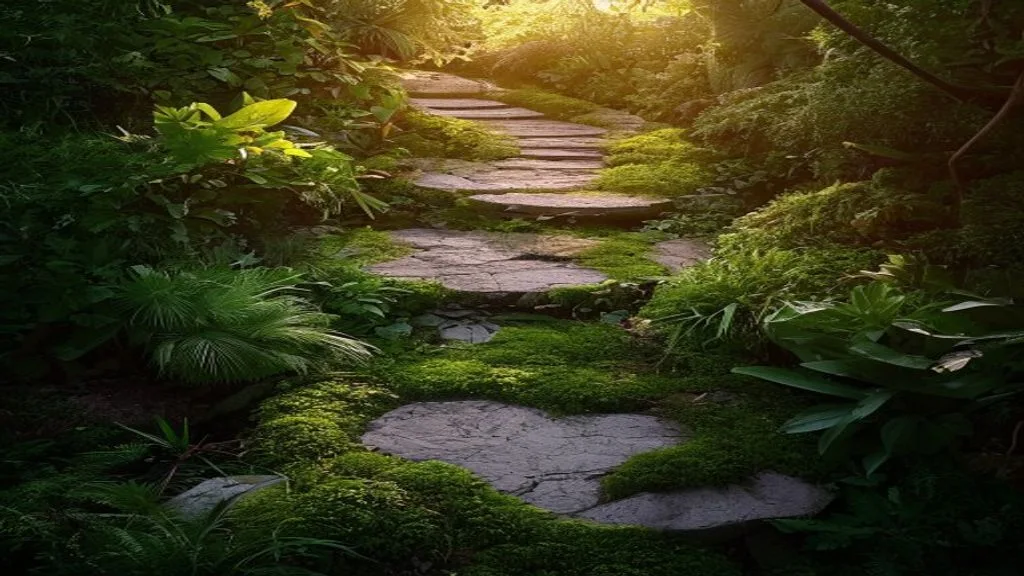
The short version: Stepping stones are the oldest piece of garden hardware that's still in active use. Japanese tea gardens have used them for at least 700 years, with strict aesthetic rules about spacing and shape. English country gardens borrowed the form in the 1800s.
Stepping stones are the oldest piece of garden hardware that's still in active use. Japanese tea gardens have used them for at least 700 years, with strict aesthetic rules about spacing and shape. English country gardens borrowed the form in the 1800s. Today, a stepping stone is one of the simplest ways to add structure and meaning to a small garden, and the materials and design choices matter more than people expect.
The Japanese origin: tobi-ishi
In Japanese garden tradition, stepping stones are called tobi-ishi (跳び石), literally "jumping stones". They were developed alongside the tea ceremony in the 1500s as a way to keep guests' clean tabi socks dry while walking through a wet garden to the tea house. The aesthetic rules are precise: stones should be irregularly shaped (not perfect circles), spaced to match a natural walking gait, and slightly sunken so the top is level with the surrounding moss or gravel.
Tobi-ishi were never meant to be decorative on their own. They're part of a larger composition where the path itself is meant to slow you down and prepare you mentally for the tea ceremony. The aesthetic, a few weathered stones in a moss field, has remained a high point of garden design.
How the form crossed to the West
English Victorian gardeners in the late 1800s borrowed the Japanese idea but applied it differently. They used uniform shapes (round or square), arranged them in straight lines, and started carving inscriptions or family crests into them. By the 1920s, stepping stones with names and dates were a standard feature of cottage gardens.
American garden design adopted a third variation, decorative concrete or resin stones with painted scenes, often given as gifts. The 9.45-inch round stone is the de facto standard size now sold across hardware stores and online retailers.
All three traditions still exist in parallel. A high-end Japanese-influenced garden might use natural stone with no inscription. A traditional English garden might have engraved sandstone. A casual American garden might use hand-painted resin with a sunflower or angel design.
Materials, from least to most durable
Hollow plastic. Cheap, light, and short-lived. Water gets in, freezes in winter, cracks. Skip these.
Concrete. Heavy, durable for decades, but unsealed concrete stains from leaf tannins over years. Sealed concrete is fine. Decorative versions are often hand-painted; the paint is the wear point, not the concrete.
Resin composite. The most common modern material. It's a polymer mixed with stone powder, cast into moulds, and hand-finished. Quality varies widely, premium versions are weatherproof for 10+ years, while cheap ones crack within seasons. Look for terms like "frost-resistant", "UV-stable", and a thickness of at least 1 inch.
Natural stone (granite, slate, sandstone). Most expensive, most durable, heaviest. A genuine engraved granite stone will look the same in 100 years as the day you installed it. The downside is shipping cost and the difficulty of repositioning a 20-pound piece.
Where to place them
A single stepping stone with meaning, a memorial, a family tree, a name, works best in a deliberate spot, not in a path. Under a small tree, beside a flower bed, near a garden bench. The stone becomes a focal point.
A series of stones works as actual pathway when they're sized appropriately (12-18 inches) and spaced for normal walking strides (24-30 inches between stone centres). Cut shallow recesses in the soil so the stones sit level with the surrounding ground, this prevents tripping and keeps the lawnmower happy.
Avoid placing decorative stones where they'll be regularly stepped on (the painted finish wears faster) or under heavy tree drip lines (constant leaf debris stains them). Morning sun, afternoon shade is the ideal for hand-painted pieces.
Why they work as gifts
Stepping stones have a quality most gifts lack: they get more meaningful over time, not less. A scarf is most meaningful when it's given. A stepping stone, sitting in a garden for years, becomes a part of the recipient's daily routine, seen every time they walk past, weathered slowly, increasingly associated with whoever placed it there.
This makes them well-suited to gifts that mark something serious: a memorial, a milestone, an anniversary, a new home. Less suited to casual gifts where you want the recipient to feel a quick lift. The stone arrives, gets placed, and then quietly accumulates meaning. That's a slow gift in a culture of immediate ones, which is part of why it lands.
Frequently asked questions
Are decorative stepping stones strong enough to walk on?
Most decorative resin stones (9-12 inches across) support adult weight when placed on a level base. Heavier solid concrete or stone versions are more durable for actual pathway use. If you'll be walking on them frequently, sink them flush into the soil and choose a piece thicker than 1.5 inches.
Do garden stones crack in winter?
Pure stone (granite, slate) and quality resin composite handle freeze-thaw cycles fine. Hollow plastic stones marketed as decorative often crack in the first hard winter, water gets in, freezes, expands. Avoid plastic for any climate that sees sub-freezing temperatures.
What's the standard size for a garden stepping stone?
9.45 inches in diameter is the de facto modern standard for decorative pieces. It's large enough to read the design from a few feet away and small enough to fit any garden. Pathway stones are larger (12-18 inches) so you can actually step on them in a single stride.
Can a garden stone work as a gift?
Yes, they're a popular memorial or milestone gift. Common occasions: a new garden for a recent home purchase, a memorial for a pet or relative, a Mother's Day gift for someone with a meaningful garden. The longer-lasting outdoor placement makes them feel more permanent than indoor décor.
Do hand-painted designs fade?
Premium pieces use UV-resistant paint that holds for 5+ years in partial shade. Direct full-day sun ages even the best paint faster. For maximum life, place hand-painted stones where they get morning or afternoon sun but not midday.