As an Amazon Associate, VEOJEIN earns from qualifying purchases made through links on this site. This never changes the price you pay.
The short version: A memorial garden is a piece of ground dedicated to remembering someone, a parent, a partner, a child, a pet, a friend. It can be a single bench under a tree or an entire designed corner of a larger garden.
A memorial garden is a piece of ground dedicated to remembering someone, a parent, a partner, a child, a pet, a friend. It can be a single bench under a tree or an entire designed corner of a larger garden. The form matters less than the intention, but a few practical choices about plants, stones, and layout make the difference between a place you'll actually visit and a project that fades into the rest of the yard. Here's how to do it well.
Choose the location first
The location matters more than the contents. A memorial garden in a place you walk past every day will be visited; one tucked behind the garage will be forgotten. Look for sightlines from your kitchen, back door, or favourite outdoor sitting spot.
Sun exposure shapes plant choices. Full sun: lavender, Russian sage, peonies. Partial shade: hostas, hellebores, ferns. Full shade: limit to a stone and groundcover. Don't fight the conditions, pick the location first, choose plants that match.
Existing features can anchor the space. A mature tree, a low stone wall, an established perennial bed. Building around something already meaningful gives the new memorial space context and saves you from designing from a blank patch.
The stone is the anchor
A memorial garden needs one focal object. Without it, the space reads as a flower bed. With it, the planting frames the focal point.
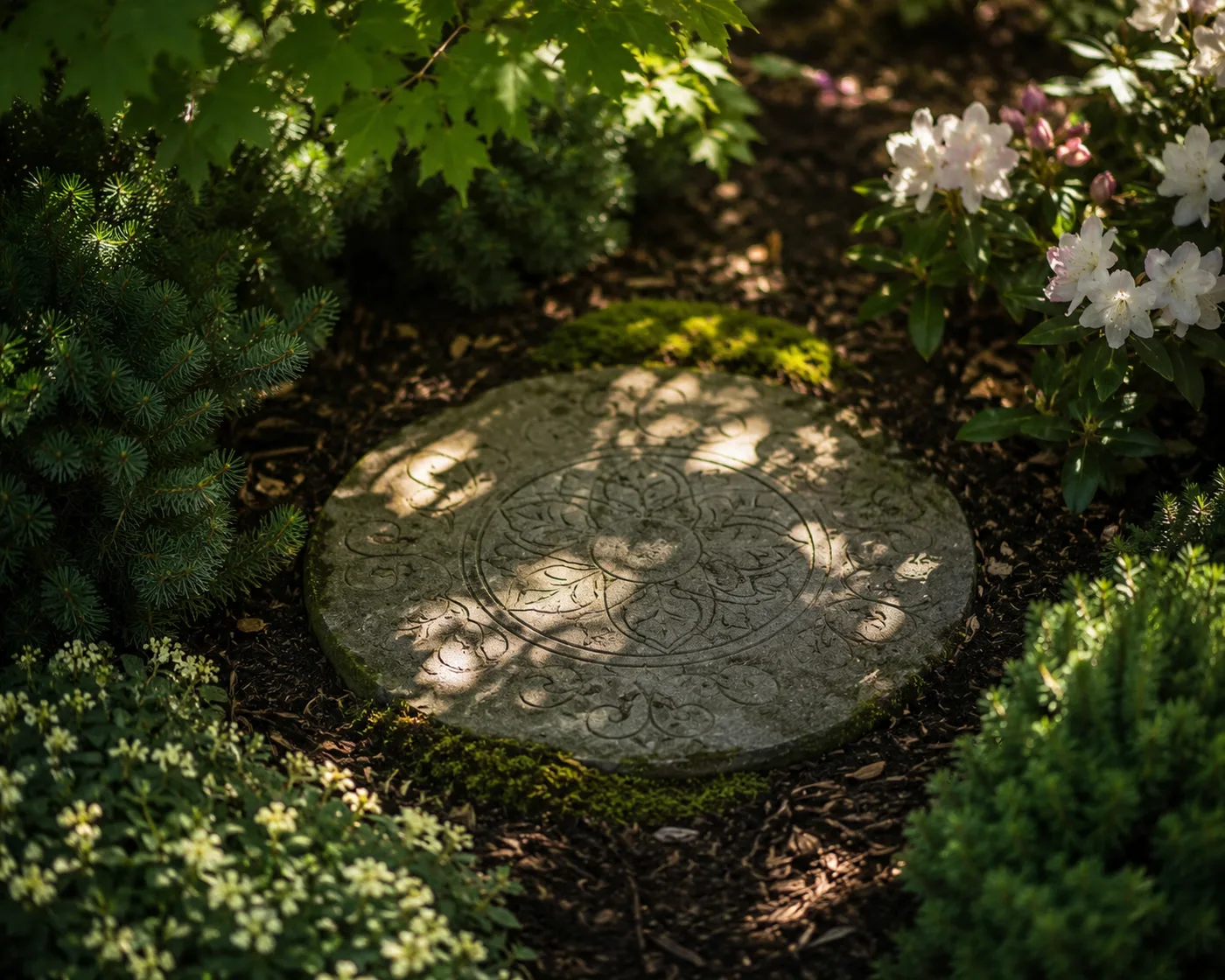
Most memorial gardens use a 9-10 inch round stone, large enough to read from a few feet away, small enough to settle into a planted area without dominating. Place it slightly recessed into the soil, level with the surrounding mulch or stone-dust. A stone that sits high on the surface looks installed; one that's slightly buried looks settled.
Hand-painted designs add colour and personality. Carved-only designs (no paint) age more gracefully but read as more austere. Pick based on the recipient's taste, not yours.
Plants that come back without fuss
Perennials are the right category, they regrow every year without replanting. The five most reliable for memorial gardens, ranked by maintenance:
Hostas. Tolerate shade, deer resistance, lush leaves. Mid-summer flower spikes. Cut back in autumn, ignore the rest of the year.
Lavender. Full sun, well-drained soil, blooms June through August. Plant three in a cluster around the stone for fragrance and bee activity.
Hydrangeas. Shrub-sized, dramatic mid-summer blooms. Pick a variety based on your climate, Annabelle hydrangeas tolerate the widest range.
Peace lilies. (Outdoors only in warm climates.) Indoor versions work in northern climates as houseplants that get brought outside in summer.
Russian sage. Drought-tolerant, blooms August into October when most else is fading. Good height contrast to a low stone.
Layout: one corner, not a cathedral
The instinct is to make a memorial garden feel substantial. Resist it. Smaller, more intentional spaces work better than ambitious ones.
A workable layout: the stone in the center, three perennial clumps surrounding it (irregularly spaced, clusters of three at unequal distances), and a single piece of natural stone or driftwood as a counterpoint. Optional: a small bench placed so you can sit and look at the stone.
Don't add a path unless you have a long distance to cover. A short path leading to a stone reads as ceremonial in a stiff way. Stone-stepping stones across grass work if you're crossing a wet area, otherwise let the planting itself indicate the space.
When to make it
There's no right time. Some people create memorial gardens in the weeks after a loss as a way to focus their grief. Others wait years until they're ready. Both are valid.
Common anniversaries to mark: the anniversary of the death, the recipient's birthday, the anniversary of major life events. Returning to the garden on these dates gives it ongoing meaning.
The hardest moment isn't always the moment you'd predict. A memorial garden made the year after a loss is sometimes barely visited; the same garden visited five years later, with the planting mature and the stone weathered, becomes meaningful in a way it couldn't have been on installation day.
Quick reference: memorial garden by space size
| Available space | Recommended marker | Plants to include | Optional elements | Approx. budget |
|---|---|---|---|---|
| Container/balcony (under 4 sq ft) | Small memorial stepping stone (9-12 in) | 1 perennial in container (lavender, sedum) | None | $60-150 |
| Small garden bed (4-25 sq ft) | Memorial stone flat on ground or vertical | 3-5 perennials, evergreen shrub | Small angel statue or solar light | $150-400 |
| Medium garden corner (25-80 sq ft) | Stone + plaque combo, OR family-tree stone | 5-8 perennials, 1-2 shrubs, ground cover | Bench (small) or birdbath | $400-1,200 |
| Large dedicated area (80-200 sq ft) | Memorial bench + flat stone | Mixed border, tree if soil allows | Path, lighting, water feature | $1,200-3,500 |
| Multi-bed garden (200+ sq ft) | Tree + bench + stone (anchor trio) | Full perennial planting, mature tree | Sundial, multiple seating points | $3,500-10,000+ |
Frequently asked questions
What size space do I need for a memorial garden?
A 4-by-6-foot patch is plenty. Many of the most-visited memorial gardens are smaller, a single bench beside a tree, or a corner of a flower bed. The size of the space doesn't determine its meaning.
What plants work best?
Perennials that come back every year, peace lilies, lavender, hostas, hydrangeas, and Russian sage all work in most US climates. Avoid annuals (gone in one season) and high-maintenance plants (you don't want grief-day to also be weeding day).
How do I choose a stone?
Pick a design that matches the relationship more than the loss. A family-tree design speaks to lineage. An angel design works in any spiritual tradition. A simple inscribed name or date keeps the focus tight. The right stone is one that doesn't make you cry every time you see it, it should bring back the person, not just the absence.
Should the garden be visible or private?
Somewhere in between. A fully private spot feels punishing and gets neglected. A fully visible spot feels performative. The best memorial gardens are visible from your normal sightlines (the kitchen window, the back porch) but slightly tucked away, you have to walk to them deliberately.
Is a memorial garden for a pet appropriate?
Yes, pet memorials are one of the most common uses of garden stones. The form doesn't change much; the scale is often smaller. A single round stone with the pet's name, placed under a tree they used to lie under, lands harder than a more elaborate setup.