As an Amazon Associate, VEOJEIN earns from qualifying purchases made through links on this site. This never changes the price you pay.
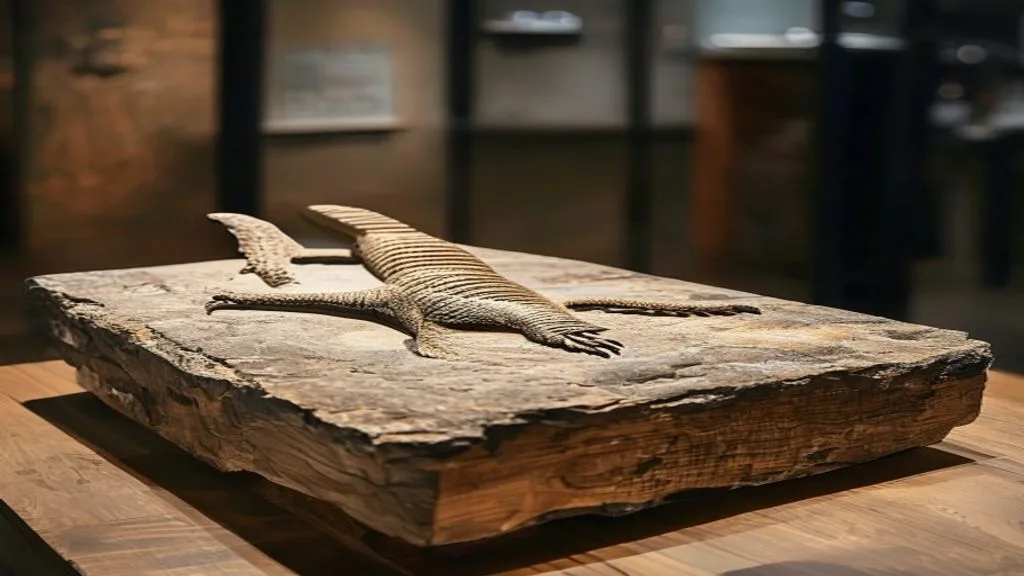
The short version: Dinosaur skeletons get the museum displays, but dinosaur footprints, formally called ichnites, tell a different and arguably richer story. A bone tells you what an animal looked like. A footprint tells you how it lived. Tracks reveal speed, social behaviour, prey-stalking, herd movements, and gait.
Dinosaur skeletons get the museum displays, but dinosaur footprints, formally called ichnites, tell a different and arguably richer story. A bone tells you what an animal looked like. A footprint tells you how it lived. Tracks reveal speed, social behaviour, prey-stalking, herd movements, and gait. The replicas you see in catalogues are casts of real fossil tracks, often with verified geological provenance. Here's how those tracks form and what they actually show us.
How a footprint becomes a fossil
An animal walking through wet mud presses a foot into the ground. The print needs four things to survive: enough cohesion in the mud to hold the shape, quick drying so the impression doesn't wash away, fresh sediment over the top to seal it from erosion, and millions of years undisturbed to lithify into rock.
Most prints fail at one of these steps. A perfect trackway, one with multiple consecutive prints from a single walking animal, requires the same conditions across the entire stretch of ground, which is even rarer. Long trackways are where the most scientific information comes from.
When a print is finally uncovered, it's usually exposed by erosion of the rock layers above. Rivers cutting through sandstone, wind sweeping through badlands, and ocean waves striking cliffs are the main agents that reveal Mesozoic-era tracks.
Reading a trackway
A single footprint tells you: the foot shape, the toe count, claw size, weight (from depth and spread), and the species (from comparison to known specimens).
A trackway of multiple prints adds: stride length (from spacing), speed (from stride and estimated leg length), direction of travel, whether the animal was walking or running, and whether it was alone or in a group.
Famous trackways have revealed unexpected things. A site in Texas preserves theropod tracks that appear to be stalking a herd of sauropods. A trackway in Bolivia shows a young dinosaur walking inside the prints of an adult, suggesting they were travelling together. These aren't speculative, the trackways are direct evidence.
Famous footprint sites
Glen Rose, Texas. The Paluxy River cuts through Cretaceous limestone exposing dozens of theropod and sauropod tracks. The site has been continuously excavated since the 1930s and is still producing new specimens.
Cal Orcko, Bolivia. A near-vertical limestone wall preserves over 5,000 dinosaur footprints from 68 million years ago. The wall was once a lake bed; tectonic uplift turned it sideways. It's the largest concentration of dinosaur tracks in the world.
The Isle of Skye, Scotland. Recent decades have produced abundant Middle Jurassic theropod and sauropod tracks along the coast. The age (~170 million years) makes them especially valuable since fossils from this period are otherwise scarce.
How replicas are made
Quality footprint replicas start with a real fossil track, scanned with photogrammetry or laser scanning to produce a precise 3D model. The model is used to make a master mould, and resin casts are produced from that mould.
Good replicas preserve detail down to the millimetre, toe pad textures, claw marks, even traces of how the mud cracked as it dried. A premium replica should look like rock, not plastic: matte finish, irregular surface texture, mineral-mottling for realism.
Cheap replicas use simplified, smoothed casts of stylised footprints. They'll read as "dinosaur footprint" from a distance but won't survive close inspection. The difference in production cost is small, the difference in result is significant.
Display: tray, wall mount, or floor
Most modern dinosaur footprint replicas are around 10 inches long, weighing 2-4 pounds. They work as three things: a desk catch-all tray (keys, coins, jewellery sit naturally in the recessed footprint), a wall hanging (mounted with two flush brackets, the print becomes a textured wall feature), or a doorway piece (placed on a low console or floor pedestal in an entryway).
The tray use is the most practical and the most overlooked. The recessed footprint is naturally the right shape and depth to hold everyday items, and the conversation factor is high, most guests pick up the piece and ask about it.
Frequently asked questions
Are dinosaur footprints real fossils?
Yes, they're a specific category of fossil called trace fossils or ichnofossils. They're not the bones or body of the animal but evidence of its behaviour. Tracks form when an animal walks through soft mud or sand that later hardens and gets buried under sediment.
How big was a real T-Rex footprint?
Adult T-Rex footprints are about 33 to 36 inches (84-91 cm) long. The famous track from Hell Creek in Montana is 33 inches. The size reflects an animal walking on three large toes with two functional digits in front and one rear toe that left a small impression.
Can you tell speed from a footprint?
Yes, with reasonable accuracy. Paleontologists measure stride length (distance between successive footprints from the same foot) and use formulas derived from modern bird and reptile locomotion. Studies of theropod trackways suggest T-Rex could run 12-25 mph (slower than once thought), while smaller raptors hit 35-40 mph.
What's the difference between a track and a cast?
A track is the original impression, the negative space left by the foot. A cast forms when sediment fills the impression and hardens, creating a positive replica of the foot. Museums display both: a real depressed track in stone, or a cast in resin showing the foot shape in relief.
Are dinosaur footprint replicas worth displaying?
Yes, they're often more visually striking than skeleton replicas because they're large and instantly recognisable. A 10-inch resin theropod footprint reads as "dinosaur" without needing any explanation. Good replicas come with provenance info, the specific site the original was found in.