As an Amazon Associate, VEOJEIN earns from qualifying purchases made through links on this site. This never changes the price you pay.
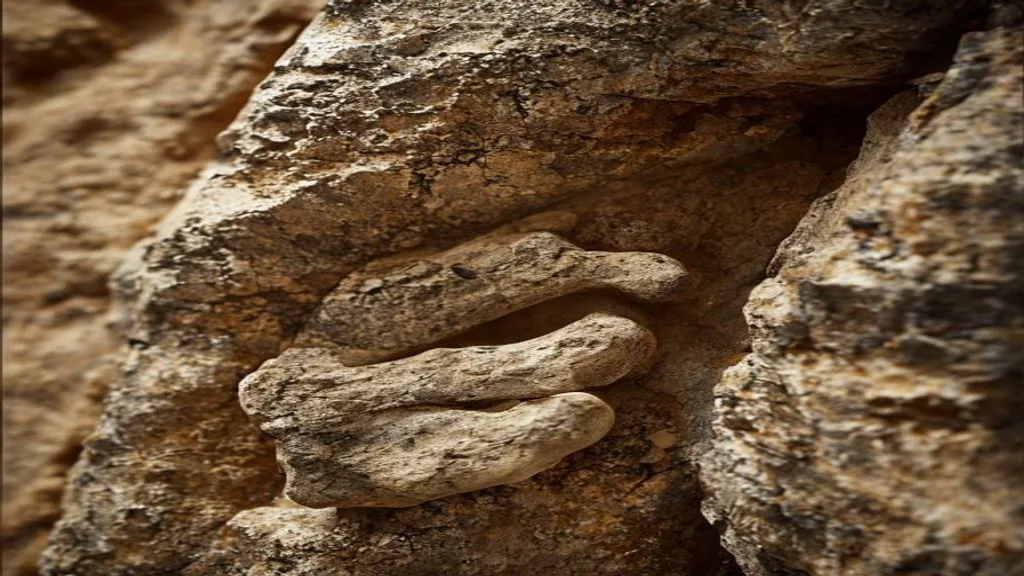
The short version: Every fossil replica is a copy of something real that survived roughly impossible odds. A T-Rex skeleton in a museum is the end product of 66 million years of geology and an entire field of human work.
Every fossil replica is a copy of something real that survived roughly impossible odds. A T-Rex skeleton in a museum is the end product of 66 million years of geology and an entire field of human work. The process that turns a dead animal into a rock isn't dramatic, but it is specific, and only a tiny fraction of animals that have ever lived become fossils. Understanding how it works changes how you look at every replica on a shelf.
Stage 1: Death and burial
For a fossil to form, the dead animal needs to be buried fast. The body has to be covered by sediment, sand, silt, volcanic ash, mud, before scavengers, weather, or bacteria can break it down. The fastest paths to burial are floods, sandstorms, volcanic eruptions, and falling into a swamp or river that's actively depositing sediment.
Most dinosaurs died in places that destroyed them: open ground, exposed to scavengers, sun, and seasonal rain. Those bones rotted within a few decades and left no trace. The fossils we have come from the small fraction of individuals that died in conditions favourable to preservation.
Famous deposits like the Hell Creek Formation in Montana represent ancient floodplains where rapid sediment deposition was common. The reason Hell Creek has so many T-Rex specimens isn't that there were extra T-Rexes there, it's that the burial conditions were unusually favourable.
Stage 2: The long wait, permineralisation
Once buried, the soft tissue decays. The bones remain. Over thousands to millions of years, groundwater carrying dissolved minerals (calcium carbonate, silica, iron compounds) seeps into the porous bone. The minerals deposit inside the bone's microscopic spaces.
The result is a hybrid, the original bone structure with mineral fillings. In some cases the original bone is also slowly replaced by minerals, atom by atom, while preserving the exact 3D shape. This is why a fossil can show the growth rings inside a bone, or muscle attachment scars on its surface: the structure is preserved, but it's literally rock now.
The mineral that does the replacing affects the colour. Iron compounds give a fossil red or brown tones. Silica gives clear or pale grey. Phosphates give black. A single fossil bed can yield bones of different colours depending on which mineral dominated the local groundwater.
Stage 3: Tectonic shift and exposure
A fossil buried 30 feet deep is useless if no one ever sees it. The bone has to be brought back to the surface, or close to it, by geological action. Mountain uplift, plate movement, river erosion, and sometimes human excavation expose fossils over time.
Most fossil sites are in areas of active erosion: river valleys cutting through sedimentary rock, badlands where wind exposes new strata each year, and coastal cliffs where the ocean steadily reveals new layers. The Jurassic Coast in southern England, where the term "Jurassic" actually comes from, is a 95-mile stretch of cliffs where new fossils literally fall onto the beach after storms.
Once exposed, a fossil has a narrow window. If it isn't found and collected within decades, weather and erosion destroy it. This is why active fieldwork matters: the supply of accessible fossils is constantly being created and constantly being lost.
Stage 4: Preparation and casting
A fossil that comes out of the ground looks nothing like the finished display. Bones are usually fragmentary, encased in matrix rock, and require painstaking lab work to expose. A skilled fossil preparator can spend hundreds of hours on a single specimen, using fine air abrasives, dental picks, and chemical treatments.
After preparation, the specimens are catalogued, photographed, and CT-scanned. The CT scans become 3D models. Those models are used to print or cast replicas, the same shape as the original, but in resin or fibreglass, light enough to mount and inexpensive enough to display.
When you buy a fossil replica today, you're typically buying a copy of a digital scan of a real specimen that took millions of years to form and decades of human work to recover. That's the chain of provenance worth remembering when you put one on a shelf.
Frequently asked questions
How long does it take for a bone to fossilise?
The most common type of fossilisation, permineralisation, where minerals replace bone tissue, takes at least 10,000 years to begin and 1-2 million years for the result to be recognisable as a fossil. Most fossils we display in museums are 50-300 million years old.
What percentage of dinosaurs became fossils?
Far less than 1%. Conservative estimates put the fossilisation rate at roughly one specimen for every 10,000-100,000 individuals that ever lived. The total number of T-Rex skeletons recovered to date is around 50, while estimates of total T-Rex individuals that ever lived run into the billions.
Can a fossil contain original DNA?
Trace fragments yes, complete sequences no. DNA degrades to unrecoverable levels within roughly 6.8 million years under ideal preservation conditions. Dinosaur DNA is far too old. Proteins have been recovered from some specimens (a 2007 T-Rex specimen yielded collagen fragments), but full genome recovery from dinosaur fossils is not biologically possible.
Why are most fossils found in the same places?
Fossilisation requires specific geological conditions, fine sediment, low oxygen, eventual exposure through erosion. The badlands of Montana, the Gobi Desert, the Patagonian steppe, and the Jurassic Coast of England share these conditions. Other places (most tropical forests, for instance) destroy organic matter too quickly for fossils to form.
Are most museum fossils real or replicas?
Most major museum mounts are casts of real fossils, not the originals. The originals are too fragile, too valuable, and too few to risk on public display. A typical museum has the real bones in climate-controlled storage and the casts in the exhibit hall. The casts are anatomically perfect copies.