As an Amazon Associate, VEOJEIN earns from qualifying purchases made through links on this site. This never changes the price you pay.
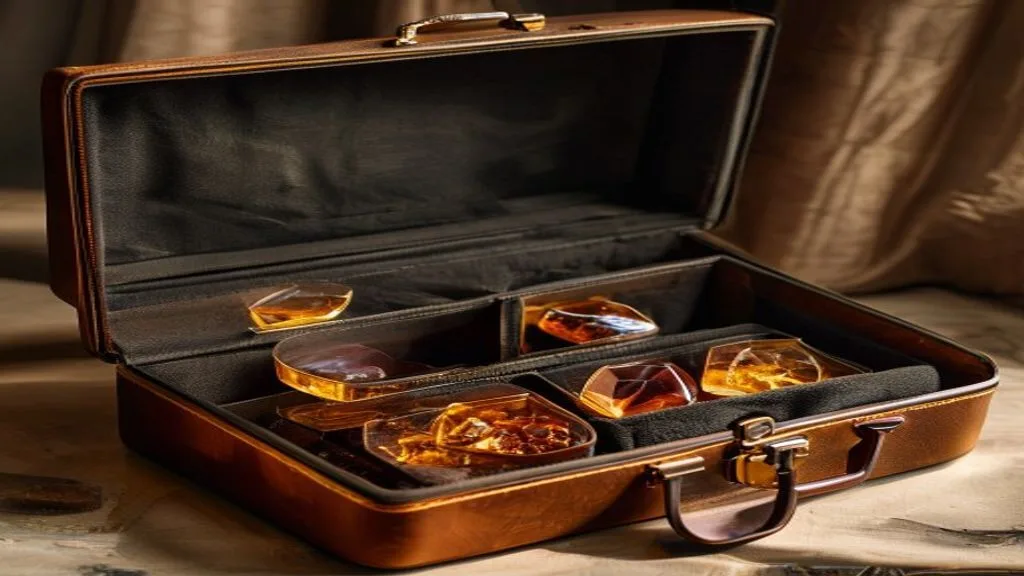
The short version: Resin and amber are tougher than glass, but not by much. The single most common way collectors lose pieces isn't accidents at home; it's a single bad cross-country move or one checked bag that got dropped. Good packing is genuinely simple, three layers, right materials, no shortcuts on the corners.
Resin and amber are tougher than glass, but not by much. The single most common way collectors lose pieces isn't accidents at home; it's a single bad cross-country move or one checked bag that got dropped. Good packing is genuinely simple, three layers, right materials, no shortcuts on the corners. This guide covers shipping, moving boxes, and air travel for amber, resin replicas, and other fragile display pieces.
Why resin breaks when it does
Cast resin is strong under compression but brittle under shock. The way most pieces actually fail is corner impact, the piece slides inside a too-loose box, hits a corner against the cardboard wall, and a stress fracture starts at the contact point. From there it propagates inward, sometimes for weeks, until the piece looks 'spontaneously' cracked on the shelf.
Bases (wooden or resin) are particularly vulnerable at joins, where the base meets the main piece. That's where vibration during shipping concentrates stress.
The fix is not 'more bubble wrap.' It's keeping the piece from moving inside the outer box at all. A piece that can't shift can't impact-fracture.
The three-layer rule
Every fragile display piece needs three independent layers when shipping:
Layer 1: Direct contact. Microfiber cloth or acid-free tissue, wrapped snugly around the piece. This prevents scratches and absorbs surface oils from packaging materials below.
Layer 2: Cushion. Bubble wrap, large-cell preferred over small-cell, at least two full wraps. Tape the seam, not the piece. Padded layer should be at least 1 inch thick all around.
Layer 3: Suspension. The piece floats in the box with packing peanuts, crumpled kraft paper, or air pillows so it never touches the outer cardboard. Minimum 2 inches of fill between the bubble-wrapped piece and the box wall on all six sides.
If you skip any layer, the chain breaks. People skip layer 1 and end up with bubble-wrap impressions baked into the resin surface. People skip layer 3 and end up with corner fractures.
Boxing, double-box if it matters
For valuable pieces over ~$80, double-box: the cushioned piece goes inside a small box, that goes inside a larger box with 2+ inches of fill in between.
Double-boxing is the single biggest survival multiplier for shipped fragile items. Single-box drops crack pieces at FedEx rates around 4%. Double-box drops crack at well under 1%.
Mark the outer box 'Fragile' but don't trust it, markings get ignored regularly. The box should survive being thrown.
Avoid mailers (padded envelopes) for any resin piece with a base. Mailers compress under stacking weight and the piece flexes against its base join.
Air travel, carry-on, not checked
If you're flying with an amber or resin piece, carry on. Always. Checked bags get tossed onto conveyors, stacked, and sometimes thrown from cart to plane. Resin pieces in checked luggage fail at a rate that's genuinely surprising.
TSA almost never has an issue with amber or cast resin, it scans like clear plastic. Be ready to unwrap it briefly at the checkpoint if asked.
Pack in carry-on: wrap in microfiber, then bubble wrap, then nest inside soft clothing in the middle of your bag (not at the top or sides). Don't pack with hard objects (books, chargers, water bottles) touching the piece.
Moving house, what to do differently
Movers throw boxes. They don't mean to. They're tired. Boxes hit edges. Pad accordingly.
For a move: each piece gets its own small box (don't pack multiple pieces in one box unless they're individually triple-wrapped and clearly separated by 2+ inches of padding). Mark the box 'FRAGILE, RESIN' and write 'THIS SIDE UP' with an arrow.
Carry the box yourself if possible. If using movers, set the marked boxes aside in a 'self-transport' pile before the truck loads.
Climate-controlled trucks matter for amber too. Resin softens slightly at high heat (>110°F), a hot summer truck can leave a piece slightly deformed at contact points. Don't let your fragile box ride 8 hours on top of a hot trailer.
Frequently asked questions
Can I use packing peanuts touching the piece directly?
Not recommended. Some peanuts (especially styrofoam) leave residue or static-cling to resin. Always have at least one layer (tissue or microfiber) between peanuts and surface.
How do I ship a piece with a separate wooden base?
Pack the base separately, wrapped in its own bubble layer, then nest both into the same outer box with 2 inches of fill between. Never ship assembled with the piece still on the base, vibration cracks the join.
Is USPS or FedEx better for fragile shipping?
Honest answer: it depends more on the route than the carrier. For under-$200 pieces, USPS Ground Advantage with insurance is fine. For $200+, FedEx or UPS with declared value gets you better claim support if something does happen.
Does temperature really affect resin in transit?
Yes, at extremes. Below ~10°F resin gets brittle and impact-fractures more easily. Above ~110°F (hot trucks in summer) some resins can soften and deform under their own weight. Avoid winter ground shipping for high-value pieces; consider expedited 2-day in midsummer.
Should I insure a $50 resin piece?
Probably not for a $50 piece, insurance fees and claim hassle exceed replacement cost. Above ~$100 declared value, insurance becomes worth it. For VEOJEIN orders shipped via Amazon, Amazon's A-to-z guarantee covers in-transit damage at no extra cost to you.